
Science is often described as a self-correcting process. New discoveries build on previous work, ideas are challenged, and evidence evolves over time. But, what happens when a published manuscript contains errors, questionable findings, or evidence of misconduct? Rather than simply deleting the paper from the scientific record, journals use several formal mechanisms to alert readers while preserving transparency.
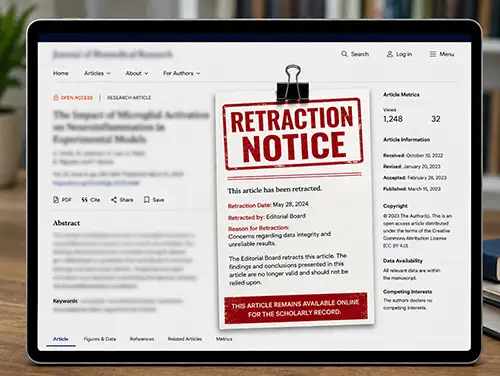
The three most common mechanisms are corrections, expressions of concern, and retractions. Although these terms are sometimes used interchangeably by the public, they serve very different purposes. Understanding these distinctions is essential for researchers, journalists, healthcare professionals, policymakers, and anyone who relies on scientific literature.
Corrections: Fixing Honest Mistakes
A correction is issued when a published article contains errors that do not invalidate its primary findings or conclusions. Science is conducted by humans, and even the most carefully reviewed papers can contain mistakes made by the humans writing and reviewing said papers.
Common reasons for corrections include:
- Typographical errors
- Incorrect author affiliations
- Minor errors in data tables or figures
- Missing acknowledgments or funding information
- Calculation mistakes that do not change the overall conclusions
For example, a researcher may discover that a graph contains mislabeled axes or that one value in a supplementary table was entered incorrectly. While these errors should be corrected for the scientific record, they do not necessarily undermine the validity of the research itself.
Corrections demonstrate that the scientific publishing process values accuracy over perfection. Rather than hiding mistakes, journals publicly document what changed, allowing readers to understand the nature of the error while continuing to use the corrected research appropriately.
Importantly, receiving a correction should not automatically damage a researcher’s reputation. Many corrections result from honest errors that are identified by the authors themselves, reflecting a commitment to transparency and scientific integrity.
Expressions of Concern: Raising a Flag While an Investigation Continues
An expression of concern occupies a middle ground between a correction and a retraction.
A journal issues an expression of concern when there are serious questions about a manuscript, but the available evidence is not yet sufficient to determine whether the questions can be addressed with a correction or a retraction. The questions can sometimes be presented to the journal through submitted letters to the editor where researchers can express their concerns over findings and methodology (hence why it’s called an “expression of concern”).
Situations that may lead to an expression of concern include:
- Allegations of research misconduct
- Questions about image manipulation
- Concerns regarding data availability
- Institutional investigations that have not yet concluded
- Conflicting evidence about the reliability of the results
Think of an expression of concern as a caution sign. The journal is informing readers that potential problems exist and that they should interpret the findings carefully until additional information becomes available (the old adage of “trust but verify”).
Expressions of concern protect both the scientific community and the authors. They alert readers without prematurely concluding that misconduct or invalid science has occurred. Once an investigation is completed, the expression of concern may be removed, replaced by a correction, or followed by a full retraction.
Because investigations can take months or even years, expressions of concern play an important role in maintaining transparency during periods of uncertainty.
Retractions: Removing Confidence in the Findings
A retraction is the most serious action a journal can take regarding a published article.
A retracted paper remains part of the scientific record, but the journal clearly indicates with a retraction that readers should no longer rely on its findings. Contrary to popular belief, retractions do not typically erase or delete papers. Instead, the original article usually remains accessible with prominent notices identifying it as retracted.
Retractions may occur for several reasons:
- Fabricated or falsified data
- Plagiarism
- Duplicate publication
- Major methodological errors
- Ethical violations
- Unreliable or irreproducible results
- Honest mistakes that invalidate the conclusions
One important misconception is that all retractions result from fraud. In reality, many retractions stem from honest errors discovered after publication. Researchers may later recognize that contaminated samples, software bugs, or statistical mistakes fundamentally altered or invalidated the study’s conclusions.
In these situations, retracting the paper demonstrates scientific integrity rather than scientific failure. Authors who voluntarily request retraction after identifying major errors help preserve trust in the research enterprise.
However, retractions involving misconduct often receive more significant public attention because they can affect public policy, medical practices, and scientific credibility. It is because of this that most authors and readers have a negative connotation with retractions.
Why These Distinctions Matter
Treating every post-publication notice as equivalent oversimplifies the scientific process.
A corrected paper may remain highly reliable and highly cited.
A paper with an expression of concern deserves careful scrutiny while investigations proceed but can still be cited.
A retracted paper should generally not be cited as evidence supporting scientific claims but can still be important when discussing the history of the research upon which the paper is focused.
These distinctions are especially important in medicine and public health. Clinical decisions, treatment guidelines, and policy recommendations often rely on published evidence. Understanding the status of a paper helps ensure that decisions are based on the most reliable and verified information available.
Journalists also play an important role. Headlines sometimes describe corrected papers as “retracted” or imply misconduct when only an expression of concern has been issued. Such reporting can unnecessarily damage reputations and mislead readers about the seriousness of the underlying issue.
The Role of Transparency
Scientific publishing depends on trust, but trust does not mean assuming every paper is perfect. Instead, trust comes from having clear processes for identifying and correcting problems.
Corrections, expressions of concern, and retractions are all examples of transparency in action. They allow the scientific literature to evolve while preserving an accurate historical record of what was published and how the research has evolved over time.
Rather than viewing these notices as evidence that science is broken, they should often be viewed as evidence of functioning quality control in publishing. Peer review catches many problems before publication, but no review process is flawless. Post-publication scrutiny by researchers around the world serves as an additional safeguard.
Final Thoughts
Scientific knowledge advances through continuous evaluation, replication, and refinement. Corrections, expressions of concern, and retractions each play a distinct role in maintaining the credibility of the scientific record.
A correction fixes errors while preserving confidence in the paper’s overall conclusions.
An expression of concern alerts readers that significant questions remain under investigation.
A retraction communicates that the findings should no longer be considered reliable because the paper’s conclusions have been fundamentally compromised.
Understanding these differences helps readers interpret scientific literature more accurately and appreciate that responsible publishing is not about avoiding mistakes altogether. It is about acknowledging errors openly, investigating concerns fairly, and correcting the scientific record whenever necessary.
In the end, these publication notices reinforce one of science’s greatest strengths: its willingness to question itself, revise its conclusions, and place evidence above ego.