
November has always felt like a good month to settle in and write, hasn’t it? The days are getting shorter, the weather is cooling off, and there’s something appealing about spending a little more time with our stories. This is one of the things we love most about autumn here at our Technica offices.
Whether you’re working on a new manuscript, trying to make progress on something you’ve been putting off, or digging into revisions, this is a great time to take a closer look at how your story is coming together.
We’re wrapping up the first three months of our series on drawing readers into our stories and keeping them there. We started by looking at those all-important first five pages and how they help establish reader trust. Last month, we talked about subtext and the power of what our characters don’t say.
This month, we’re looking at something that can truly make or break a manuscript, even when the writing itself is really good.
What is this magical secret ingredient?
SCENE PURPOSE.
Think about this: Have you ever been reading a book, enjoying the characters and the writing, when, huh 🤔, you realize you’re getting a little bored? Nothing is necessarily wrong. The dialogue is fine, the descriptions are lovely, and the characters are doing all the things. But despite all of this, the story doesn’t seem to be going anywhere, or at least nowhere interesting.
Now put on your writer hat. Have you ever experienced the sense that something is off with your own manuscript?
This is something we see more often than you might realize. Writers spend so much time making sure their scenes are well written that they sometimes overlook a more fundamental series of questions:
Why is this scene here in the first place?
What is its point?
What is its JOB?
Let’s talk about this flawed idea: Just Because Something Happens Doesn’t Mean the Story Is Moving
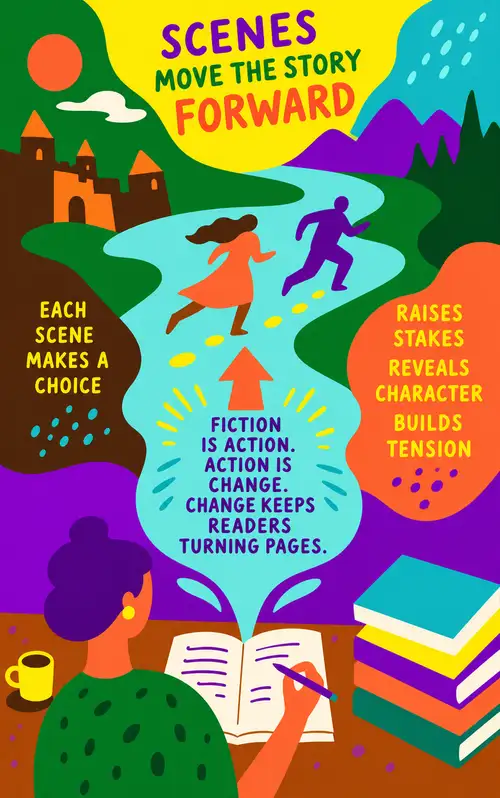
ACTIVITY does not equal PROGRESS.
Your protagonist can spend an entire chapter running errands, arguing with her sister, meeting a friend for coffee, and discovering that her car won’t start. In that scene, plenty is happening, but the big question is: does any of it actually move the story forward?
Let’s dig a little deeper. Let’s say your protagonist meets her sister for coffee, and they talk about their childhood, share some funny stories, and chat about their plans for the weekend. It’s a pleasant scene, if vanilla. Sure, we learn a little about their relationship, and maybe there’s some entertaining dialogue, but by the end of it, nothing’s changed. That’s SO important.
At the end of any given scene, there must be change.
Now reimagine that same coffee date, except this time, at some point in the conversation, your protagonist casually mentions she’s planning to sell their childhood home.
Her sister goes quiet and sets down her coffee.
“You can’t sell the house.”
“Why not?”
“Because Mom made me promise.”
Isn’t that A LOT more interesting?
The scene is essentially the same. It’s still two sisters having coffee. But now there is something at stake. There’s a disagreement, an unanswered question, and…ooo…possibly a family secret. As readers, we want to know what’s going to happen next.
But something else is also happening here. The relationship between the sisters has shifted. One knows something the other doesn’t, and whatever that secret is will affect what happens next.
The coffee date scene between sisters now has a purpose.
As writers, the big question we have to ask is: What Is a Scene Supposed to Accomplish?
We’re not saying that every scene needs a dramatic confrontation, some sort of shocking revelation, or a cliffhanger. That would actually be exhausting to read!
No, sometimes a quieter scene is just what a story needs, especially after something emotionally intense has happened (this is the concept behind scene and sequel). Characters need room to process what’s happened, and readers need those moments, too.
But always keep in mind that even a quiet scene needs to accomplish something.
A scene might move the plot forward by:
- Revealing something important about a character
- Complicating a relationship
- Introducing new information
- Deepening the emotional stakes
- Planting a clue that won’t make sense until several chapters later
Often, a scene will accomplish several of these things at once.
Let’s go back to the scene about the sisters having coffee. In the revised scene, we’ve introduced a possible family secret, created tension between the characters, and given our protagonist a new problem to deal with. Depending on the story, that conversation might also make one of the sisters, for example, reconsider something she’s always believed about her mother.
That’s a lot for one scene to accomplish, right? And none of it required an explosion, a car chase, or anything particularly dramatic!
The important thing is that the conversation matters to the larger story.
The Technica Question
Here’s a question we like to ask writers when we’re looking at scenes that aren’t quite working:
What’s different at the end of this scene compared to the beginning?
Think about a mystery. Your sleuth begins a scene convinced that one particular suspect is guilty. She asks a few questions, discovers something she didn’t know, but then she leaves wondering whether she’s been investigating the wrong person.
That’s a pretty big change and it propels the story forward.
Or maybe your protagonist begins a conversation determined to keep a secret. By the end, she’s told someone the truth, and now she has to deal with the consequences.
Just remember: change doesn’t have to be huge. A character might come away with a new suspicion, make a decision they’ve been avoiding, or realize that someone they trusted hasn’t been entirely honest.
Even a scene where two characters sit quietly together can change something. Maybe one finally accepts comfort from the other, and their relationship grows or is different because of it. What we’re looking for is some kind of movement.
If your characters enter a scene and then leave it with exactly the same knowledge, relationships, goals, and circumstances, we suggest that you ask whether the scene is accomplishing what you intended.
Watch Out for Scenes That Keep Covering the Same Ground
This is one of those problems that’s surprisingly easy to miss when you’re writing a novel, especially when you’ve been working on it for a long time.
Let’s say you’re writing a mystery, and your sleuth suspects the local baker of murder. In one scene, she discusses her suspicions with her best friend. In the next, she talks about the baker with her neighbor. A chapter later, she has another conversation about him with the police chief.
Individually, those scenes might be interesting. You might have some (killer) dialogue, and each conversation could reveal something about the people involved. But if all three conversations cover essentially the same information, readers aren’t learning anything new about the investigation.
Now, what if the conversation with the neighbor reveals that the baker lied about her whereabouts? And when your sleuth approaches the police chief, she discovers he’s already ruled out the baker because of evidence she didn’t know existed?
Now we’re getting somewhere! We’re covering new ground. Each conversation changes what the sleuth knows, which in turn changes what she does next.
We encourage you to pay attention to this during revision. Sometimes we repeat information because we want to make sure readers remember it. At other times, we write several versions of essentially the same scene without realizing it.
If you notice that happening, think about whether those scenes could be combined or whether each one could reveal something different.
Scenes Should Build on One Another
We also recommend looking at how your scenes connect with one another. You can have a manuscript full of individually interesting scenes that somehow still feel disjointed. Here are four things that might happen in a sample scene:
- The protagonist argues with her mother
- She goes to work
- She meets a friend
- She discovers something suspicious
Maybe all of these things belong in the story, but if they don’t influence one another in some way, the story can begin to feel like a collection of separate events rather than a developing narrative.
Let’s revamp that example a little:
- Your protagonist argues with her mother about selling the family business
- She’s frustrated and determined to prove she can manage things herself
- When she arrives at work, she makes a decision she might otherwise have thought through more carefully
- That decision creates a problem, and now she has to deal with the consequences of that situation
The argument with her mother matters because it affects what she does at work. And what happens at work creates the circumstances for the next scene. Scene and sequel.
This type of scene-building will help give the story a stronger sense of forward movement.
Now, not every scene needs to lead directly into the next one. Maybe time passes, we change locations, or we shift to another point of view. But regardless, readers should be able to see how the events of the story are connected and why they’re important.
Those Little Darlings
We know this is painful! Sometimes we write a scene we absolutely love. We’ve written funny dialogue, descriptions of scenery, and, wow, there’s a moment between two characters that makes us smile every time we read it.
Still, when we take a closer look at what the scene actually accomplishes, we realize it isn’t doing very much.
Believe us when we say we’ve all been there. It goes with the territory of being a writer, but before you cut one of your little darlings, see whether you can give it a little more to do.
Could that conversation reveal something important about a relationship? Could you introduce a complication or plant a detail that becomes significant later? Maybe your character makes a decision that will have consequences a few chapters down the road.
Sometimes a scene doesn’t have to go away. Sometimes it just needs a stronger reason to exist.
There may be other times when you realize that everything important in five pages you’ve written could be accomplished in a single paragraph somewhere else. And sometimes, as much as you love it, you have to face the fact that a scene simply doesn’t belong in this particular story.
That can be hard to accept, especially when you’ve spent hours getting the words just right. It can be brutal! But one of the realities of revision is that good writing isn’t always necessary writing.
You can love a scene and still decide your manuscript is stronger without it.
Give Your Scenes a Little Checkup
If you’re working through a manuscript this November, here’s an exercise worth trying.
Choose three consecutive scenes. Don’t cherry-pick the ones you already know are working. We suggest you choose three random ones that appear one after another in your story, or better yet, three that you feel are lacking in some way.
For each scene, ask yourself:
- What does my character want? It doesn’t have to be a major goal, but there should be something the character is trying to accomplish.
- What’s getting in the way? This could be another character, an unexpected circumstance, an internal struggle, or even a mistaken assumption.
- What changes by the end? What does the character learn, lose, gain, decide, or begin to question?
- Why does this scene matter to the larger story? What would readers miss if it disappeared?
- How does it affect what happens next? Does the scene create a consequence, raise a new question, or change the character’s direction?
Three and four are especially important here. If you have trouble identifying what changes or why the scene matters, that’s a pretty good indication you should take another look. The point isn’t to find something wrong with every chapter. It’s to understand what each scene contributes to the story you’re telling.
Big Technica Takeaways
- Every scene needs a purpose, but not every scene needs huge drama.
- Just because characters are busy doesn’t mean the story is moving forward.
- Look for something that changes between the beginning and end of a scene.
- Scenes should build on one another rather than repeat information readers already know.
- Before cutting a scene, think about whether it can accomplish more.
- Sometimes the best revision is recognizing what your story doesn’t need.
So, as you settle into your writing this November, take a little time to look at the bigger picture. You don’t have to revise your entire manuscript or rethink every chapter. Start with a few scenes and see whether they’re accomplishing what you intended.
And if you’re drafting something new, keep scene purpose in the back of your mind as you write. You don’t have to get everything right the first time, but knowing what your character wants and what changes in a scene can help you find your way forward when you get stuck.
Have a wonderful November, and happy writing!
The Technica Editorial Team
P.S. Looking Ahead
As we head toward the end of the year, we’re going to shift gears a little. In December, rather than diving into another craft topic, we’re going to take some time to look back at the writing year. What did you accomplish? What did you learn? What challenged you? What might you want to approach differently next year?
We’ll also revisit some of the topics we’ve explored in 2026 and share a few of our favorite resources to help you take stock of your own writing.
And then get ready! As we move into 2027, we’re expanding our focus to explore more of the challenges writers face at every stage of the process, whether you’re working on a novel, a nonfiction book, or an academic manuscript. We’ll be talking about finding your central idea, making sense of editorial and peer-review feedback, strengthening your manuscript’s structure, and knowing when it’s ready to submit. Stay tuned!
P.P.S. If you want to dig a little deeper into the topic of scene, sequel, and change, watch these YouTube videos:
The Scene Question that Keeps Readers Turning the Pages: https://youtu.be/68X9aL8sidU?si=2bxc0RZ1YMdHoUwg
Why Your Scenes Feel Random: https://youtu.be/82bVHhkAU9Y?si=fDAqWOfrhjO56QZE
The One Thing That Makes Scenes Flow: https://youtu.be/gcDVBa-MENg?si=qR_vtixOQXm8Vy9v