How to get started on getting started.
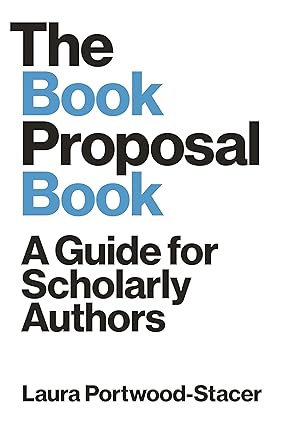
Many scholars—whether newbies or old-hands with writer’s block—easily get stuck when the time comes to present their book pitch to scholarly publishers. Writing eloquently to make a good case for a book pitch is already difficult, but it becomes even more stressful when a scholar tries to consider what an editor will decide and why. Even though a publishing professional will try to judge a potential book on its own merits, patterns still emerge in what projects make the cut. There’s no clear-cut solution or series of answers, no one-size-fits-all…but handbooks like Laura Portwood-Stacer’s The Book Proposal Book: A Guide for Scholarly Authors are there ready to educate and assist those who’ve gotten stuck or turned around trying to reach their goal.
The first thing to remember: an author, especially one trying to publish in a scholarly field, is publishing their writing for the readers. Getting that aspect prepared means that, even before the actual publication, a would-be book needs to have preliminary readers, such as an acquisitions editor, expert peer reviewers, a publishing editorial board, and more—all able to vouch for the book’s ability to appeal to a much wider audience in a way that will make it a good investment. To reach even those readers, this is where a book proposal package comes in: a prospectus, an author CV, and a writing sample. The prospectus is composed of a working title, book overview, a description of the book’s potential audience(s), a discussion on the book’s place in a larger marketplace, a table of contents with chapter summaries, technical details of the manuscript, and the author’s qualification information.
The biggest impression an author should be leaving on their “buyers” in the early publishing stages is that their project is worth investing in. The “buyers” or acquisition editors are looking for books with strong arguments, with important findings, interesting topics, and unique value. They’re the middle people—the connection between writer and reader—and so they’re looking for value in an exchange. Book proposals aren’t given to casual book readers, they’re given to smart people who want to hear about something interesting, and that means book proposals should be written not “defensively”, but with a proactive stance.
As for the ultimate audience, post-publication, that’s a subject that the publisher will have plenty to ask about and discuss. It helps both in how the book is edited, in terms of the best structuring and writing possible, and for the ultimate marketing and distribution. Not everyone along the route, such as designers and salespeople, will understand the subject as well as a potential audience of experts, so the presentation has to be at least coherent to outsiders. Types of audiences for scholarly books tend to include other scholars (naturally), students, practitioners (such as policymakers, activists, advocates, etc.), and readers simply generally interested in the topic.
The project description/overview is the prospectus’ center, and Portwood-Stacer provides a helpful template structure for readers, each point representing a paragraph: hook and the statement of the book’s biggest takeaway, a more in-depth statement of the central argument and conclusion, why the book’s findings matter, a few key concepts/theories to discuss in relation to the book’s relevance in a larger scholarly area, what evidence and methods the book uses for its argument, the book’s overall structure and arc, and the target audience. A decent length might be between 1,200 and 1,500 words, roughly 2—3 single-spaced pages, but some editors and publishers have different expectations or outright requirements.
Effective chapter summaries have to contain a chapter title—originality isn’t the key at this point; anything would be fine—the chapter topic, the argument/point regarding the chapter’s topic, the objects and methods of analysis, the connection between the chapter’s focus and the book’s thesis, the relation of said chapter to the book’s arc, and a word count. Looking at other books similar to the one at hand can help in getting an idea on what works, while chapters are best organized to help the book’s thesis and further organization. It’s important to remember that at this stage, a book’s structure is not set in stone, and there’s enough time to develop a new organization during revisions, so focusing on the content and having something good to show is more important than achieving perfection.
There are a lot of factors that will go into an editor’s decision on whether a book is financially worth the investment, even beyond the costs (money and time) of marketing and outright production: the book’s literal size, copies to print, the types of printing involved, designs, royalties, and more. The prospectus is expected to touch on, though not all the subjects, the manuscript’s length and the nature of any art if art is included. Publishing takes a long time, and coordinating involves delicate scheduling, so an author should already have answers ready on what is already finished and ready for review if the editor needs a look, and the answer for when the entirety of the manuscript will be finished.
The “Moment of Judgment”, when the reader critiques and reports come, doesn’t necessarily have to be a complete rejection (or a complete acceptance). The critique might be seemingly minimal enough that an editor believes that a good response letter can convince the larger editorial board that any larger problems can be fixed in revision, and then gain their approval; that the project itself is worth believing in even if it’s not strong enough at the moment in its current form, and request further revisions before a resubmission. Whether a clear-cut rejection, acceptance, or somewhere in the middle, an author has to decide whether the answer is worth further investment into their work.
The Book Proposal Book provides, along with several chapters of good advice, a diagram early in the book to illustrate the many steps of the acquisitions process from presubmission stage to contract stage, a checklist near the end for its readers to use as a basic quality check for their proposal, and suggestions on further reading to help readers with specific aspects of the entire process. With so many resources, so much insider knowledge, and an author with plenty of expertise formed from experience to pass along, this book is the best place to begin at the beginning.
By Grace Dietz