In the past, scientific publishing moved at the pace of glaciers—deliberate, weighty, and often frustratingly slow. And there was good reason for this. Peer review is an important part of scientific publishing that is necessary to weed out research that is not up-to-snuff. However, preprints have changed the speed with which research is disseminated. With a single upload, researchers can share findings with the world before formal peer review, bypassing months (or years) of waiting. This shift has sparked both enthusiasm and unease across academia, journalism, and the public sphere.
Preprints—research papers shared publicly before undergoing peer review—have become a defining feature of modern scholarship. Platforms like arXiv, bioRxiv, and SSRN host hundreds of thousands of these early-stage papers, covering everything from theoretical physics to public health. We previously discussed preprints back in 2023, and the need to verify their information as they grew in popularity during the COVID era. The need to verify comes from the fact that preprints promise speed and accessibility, while also raising questions about quality, credibility, and unintended consequences.
So, are preprints a revolution in knowledge sharing or they a dangerous new way of spreading potential misinformation? The answer, as it turns out, is both.
The Pros of Preprints
1. Rapid Dissemination of Research
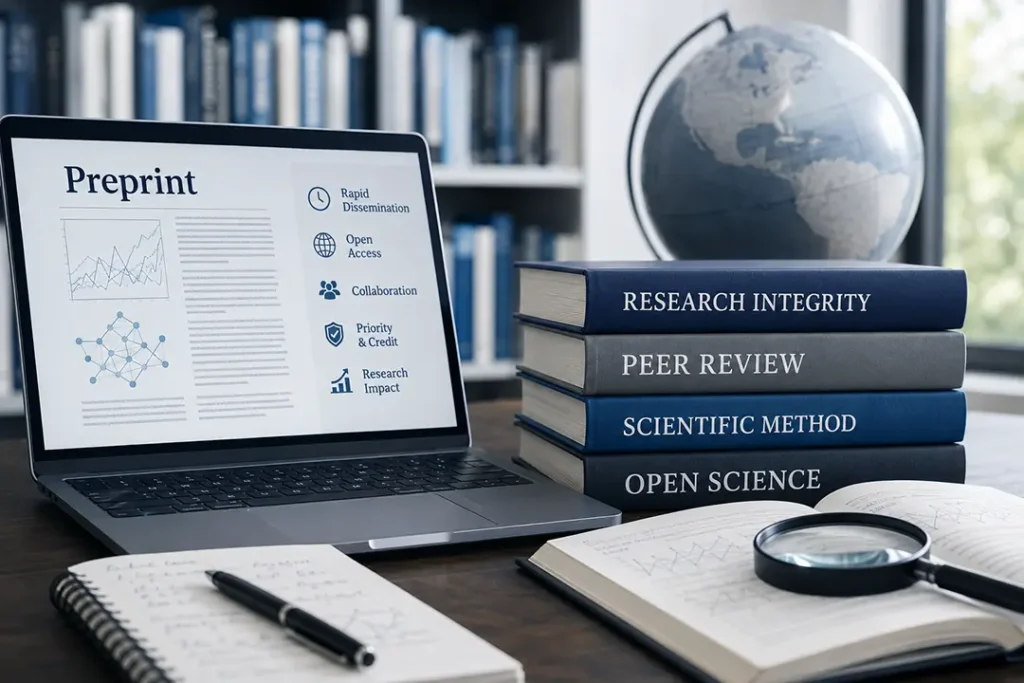
Perhaps the most obvious advantage of preprints is speed. Traditional publishing pipelines can be notoriously slow, with peer review, revisions, and editorial decisions stretching over many months. This process seems to be getting even slower as reviewer fatigue continues to plague many journals. Preprints allow researchers to share their findings almost immediately.
This rapid dissemination can be especially valuable in fast-moving fields. During global crises—such as pandemics or climate-related disasters, things that the global population have experienced in spades in the last decade—waiting for formal publication can mean missed opportunities to act on critical insights. Preprints enable scientists to communicate findings in real time, accelerating collaboration and response.
In essence, preprints turn the academic world into a live conversation rather than a delayed broadcast. For reference, There were over 19,000 manuscripts about COVID-19 shared in the first four months of the pandemic, and one-third of these papers were preprints.
2. Increased Accessibility and Open Science
Preprints are typically free to access, removing the paywalls that often restrict journal articles. This democratizes knowledge, allowing researchers, students, policymakers, and the general public to engage with cutting-edge work regardless of institutional affiliation.
For scholars in underfunded institutions or developing countries, this accessibility is transformative. It levels the playing field, making it easier to stay current and contribute to global discussions.
Preprints also align with the broader movement toward open science, where transparency and sharing are prioritized over exclusivity.
3. Early Feedback and Collaboration
While preprints are not peer reviewed, publishing a preprint invites feedback from the global research community. Instead of relying solely on a handful of anonymous reviewers, authors can receive comments, critiques, and suggestions from a much wider audience.
This can improve the quality of the final paper. Errors can be caught earlier, methodologies refined, and interpretations challenged. In some cases, preprints even lead to new collaborations, as other researchers discover shared interests or complementary expertise with plans to work on future publications.
Think of it as a draft released into the wild, where the crowd helps sharpen the argument before it’s etched in stone. We’ve seen similar systems to preprints set up in other artistic mediums, such as the Black List in screenwriting, where unfilmed screenplays are published giving writers the ability to have their work read and critiqued without the stress of filmmaking.
4. Establishing Priority
In competitive fields, timing matters. Preprints provide a timestamped record of discovery, allowing researchers to establish priority for their ideas and findings.
This can be crucial in areas where multiple groups are racing toward similar breakthroughs. If I had a dollar for every author who requested updates on their paper’s peer review status because the research was incredibly timely, I wouldn’t be able to retire but could go on a very happy shopping spree. By posting a preprint, authors can claim intellectual territory without waiting for journal peer review and acceptance.
5. Career Visibility and Momentum
For early-career researchers, preprints can serve as a portfolio of work in progress. They demonstrate productivity and engagement, even before formal publications appear.
Hiring committees and grant reviewers increasingly recognize preprints as evidence of scholarly output. This can help researchers maintain momentum in a system where long publication timelines might otherwise create gaps.
The Cons of Preprints
1. Lack of Peer Review
The most significant and obvious drawback of preprints is also their defining feature: they are not peer-reviewed. This means the findings have not been vetted for accuracy, rigor, or validity by other researchers in the field of study.
While many preprints are later published in reputable journals after completing peer review, others may contain errors, flawed methodologies, or unsupported conclusions. Without the filter of peer review, readers must approach preprints with a critical eye.
For experts, this may be manageable. For non-specialists, it can be a minefield.
2. Risk of Misinformation
Preprints can be misunderstood or misused, particularly when picked up by media outlets or shared on social media. Preliminary findings may be reported as definitive, leading to confusion or even harm by lay people.
This risk became especially visible during the COVID-19 pandemic, when preprints on treatments, transmission, and vaccines circulated widely—sometimes shaping public perception before being validated or corrected. Multiple examples of preprints with faulty data littered servers and were picked up by both mainstream and social media sources with articles arguing that COVID-19 was manufactured from HIV, articles overexaggerating the helpfulness of ivermectin in treating COVID-19 symptoms, and articles presenting an unfounded link between vaccines and myocarditis seeing the light of day.
In this sense, preprints can act like sparks in dry grass: they spread quickly, and not always in controlled ways.
3. Variable Quality and Noise
Because preprint platforms have lower barriers to entry than traditional journals, the quality of submissions can vary widely. While many are high-caliber studies, others may be incomplete, poorly designed, or speculative. Some authors might even publish a preprint knowing that their research is too preliminary or of poor quality to make it through peer review.
This creates a signal-to-noise problem. Researchers must sift through a growing volume of material to identify what is credible and relevant. The sheer abundance of preprints can be both a blessing and a burden.
4. Potential for Scooping and Intellectual Theft
While preprints can help to establish priority, they also expose ideas early. This openness can create anxiety about being “scooped,” where others build on or publish similar work more quickly.
Although the timestamp provides some protection, not all academic systems or cultures weigh preprints equally. In some cases, disputes over credit can still arise.
5. Impact on Public Trust
The visibility of unreviewed research can blur the line between established knowledge and preliminary findings. As noted previously, “trust, but verify” is the cornerstone of interacting with preprints. When preprints are later contradicted or retracted, it may erode public trust in science.
While the distinction between a preprint and a peer-reviewed article is known by expert researchers, the distinction is not always clear among lay audiences. This can lead to skepticism or confusion, particularly when scientific conclusions appear to shift over time.
Finding the Balance
Preprints are neither a panacea nor a problem to be eliminated. They are a tool—powerful, imperfect, and still evolving.
The key lies in how they are used and interpreted. Researchers must be transparent about the limitations of their work. Journalists and communicators must exercise caution and do research when reporting on preprints. Readers, in turn, must develop a degree of scientific literacy, understanding that not all studies carry the same weight.
Some preprint platforms are experimenting with hybrid models, incorporating community review, moderation, and quality checks. Meanwhile, journals are adapting by allowing or even encouraging preprint submissions alongside traditional publishing.
The ecosystem is shifting toward a more fluid model of knowledge sharing, where speed and scrutiny coexist rather than compete.