Recent statistics have shown that watching online video is literally like a part-time job; the average person does it for 17 hours each week.
And more than half of those folks—51 percent, to be exact—are more likely to share video with friends than other types of content.
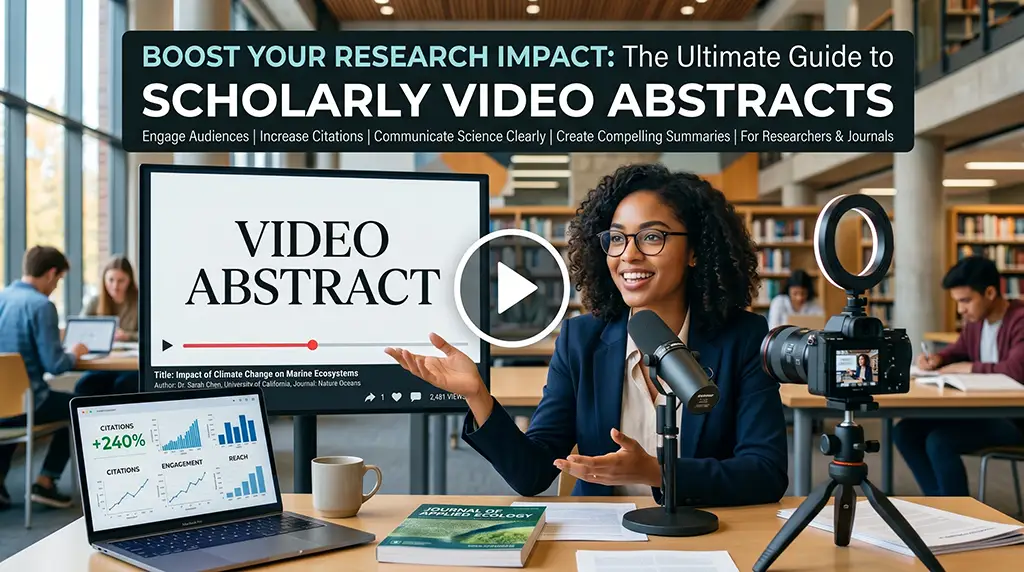
These types of numbers point to video abstracts as an attractive option for authors of scholarly journal articles who want to make their work more appealing, visible, and accessible. The purpose of video abstracts is similar to written abstracts: to hit the main points of the research and encourage potential readers to delve into the rest of the article. And as time goes on, these video abstracts have the potential to become more than just a desirable choice—within the next decade, they may very well turn into a “must-have.”
That’s why now is the time for authors to begin asking themselves the important questions about how to create the best video abstract possible. The first step is to gather information about the resources at their disposal, both in terms of time and money investments. Next comes choosing a “hook” that will cause possible listeners to stop scrolling and start listening right away. And finally, since AI is literally everywhere in today’s world, authors should consider if—and how—it might be productively used in the video abstract production process.
What Are My Resources?
Most scholarly articles are on a deadline, which means there might not be time to enlist much, if any, professional help in creating a video abstract—not to mention the financial price tag of doing so. Typically, it’s much more feasible and realistic to use free or low-cost self-editing tools.
Even then, though, time is of the essence. Trying to create a masterful abstract can be a lengthy process if you don’t know how to maximize the usefulness of these tools.
Luckily, there are many ways to mitigate this potential roadblock. Reaching out to freelance video editors is one way to ensure quality without having to spend too much money in the process. Another step might be brainstorming about who in your author group is talented in certain aspects of video creation, such as lighting and narration—or, who in the group might be acquainted with someone else who can help with those types of points.
Before even picking up the camera to record the abstract, make an outline to plan ahead for each of the major steps, such as narration recording and on-site shooting. Figuring out how long each step will take—and planning accordingly—will prevent the group from becoming disappointed if things don’t go as planned due to miscalculation of resources, both in terms of time and money. The last thing your author group needs is unforeseen headaches and hangups that could derail things when time matters most.
What’s a Good Hook?
Let’s say you’re scrolling through videos on YouTube or Google about social and financial problems in the United States. You come to one where a person dressed in a suit and tie, standing against the backdrop of the New York City skyline, says, “I might be dressed up, but my budget is very limited.”
Now let’s say you’re coming to the same video of the same person, wearing that same suit and tie, with that same backdrop. Only this time, instead, his opening line is, “I might be dressed up, but I can’t spend more than three dollars a day.”
…Chances are, you’re much more likely to keep watching after seeing option number two.
The purpose of a video abstract is to convince potential readers to stop scrolling and keep watching. And the first couple of seconds of footage are what matters most in making this happen. So, choosing a good “hook” for those crucial opening moments could mean the difference between a thousand views and over a hundred thousand.
And keep in mind that the best “hooks” aren’t just about reeling in viewers who are subject matter experts in the topic at hand—they are about reeling in anyone who happens to be scrolling. So, try to steer clear of any technical language that these “average Joe” viewers might not understand; less is more!
How Might AI Be Used?
AI is here to stay in all aspects of scholarly publishing, and video abstract creation is no exception. But if you plan to just plug your article into ChatGPT and ask it to guide you toward making an effective video abstract, you’re going to be in trouble. The end results will look mediocre and haphazard at best—and at worst, your laziness in relying on AI will be obvious, leading editors to hit the “immediate reject” button right away on your submission.
Instead, use AI as a tool to refine your work, not fully develop it. For instance, once both your paper and your video abstract are finished, it might be helpful to ask an AI tool to evaluate whether your abstract hits all of the major points of the research. This could be valuable in focusing on the big picture instead of getting bogged down in details—a common problem for authors when creating abstracts.
Another effective use of AI in generating video abstracts is speeding up the tedious grunt work tasks, such as creating captions and drafting scripts. Again, though, be aware that there’s a difference between AI helping with these kinds of tasks and doing them for you; the end product must still be carefully vetted by at least one human. But the idea is to cut down on wasted time so that an author can instead spend every minute focusing on what matters: making the video abstract clear, accurate, and attractive.
Other Types of Media—and, Specifically, Podcasts
While video abstracts can certainly be an effective way to add a video component to a scholarly journal article, they might not always be the best way to go in terms of multimedia. If the article contains more in-depth or complicated concepts that can’t be summed up in a few minutes, linking it to a podcast might instead be the path to follow.
On average, about 584 million people listen to podcasts on a monthly basis—and those listeners typically spend 7 hours per week checking out podcasts—so that’s pretty much a guarantee that an audience will be there! And podcasts can often add an element of detail that a brief abstract cannot.
Say, for example, a medical journal is publishing an article about a case study of a complex and relevant medical condition, such as Parkinson’s disease or ALS. Conducting an interview with a patient who is living with the condition might give added insights—and a personal touch—that the author would be unable to attain by simply describing the symptoms and medications in the form of a written piece. And an abstract likely could not reach this goal, either. But a podcast likely checks all of these boxes!
In the second installment of this two-part series, we will discuss some of the strategies for incorporating multimedia into a scholarly article in podcast form, whether instead of or in addition to a video abstract. There’s no “right” or “wrong” answer of which media form to use for which article—it’s all about the right techniques once you have made that choice!
By Anne Brenner