Predatory publishing has unfortunately become a big business for con artists. In the realm of journal publishing, predatory publishers have sadly been prominent for years now. The need for scholars to publish regularly and quickly has led to numerous scam journal societies popping up offering publication but at a fee. The number of predatory publishers increased dramatically during the COVID-19 era. These predatory journals promote articles with inaccurate research and articles without peer review. Reputable authors have fallen prey to predatory journals due to the promise of quick publication. Predatory publishers are now expanding and targeting not just journals, but also the book industry.
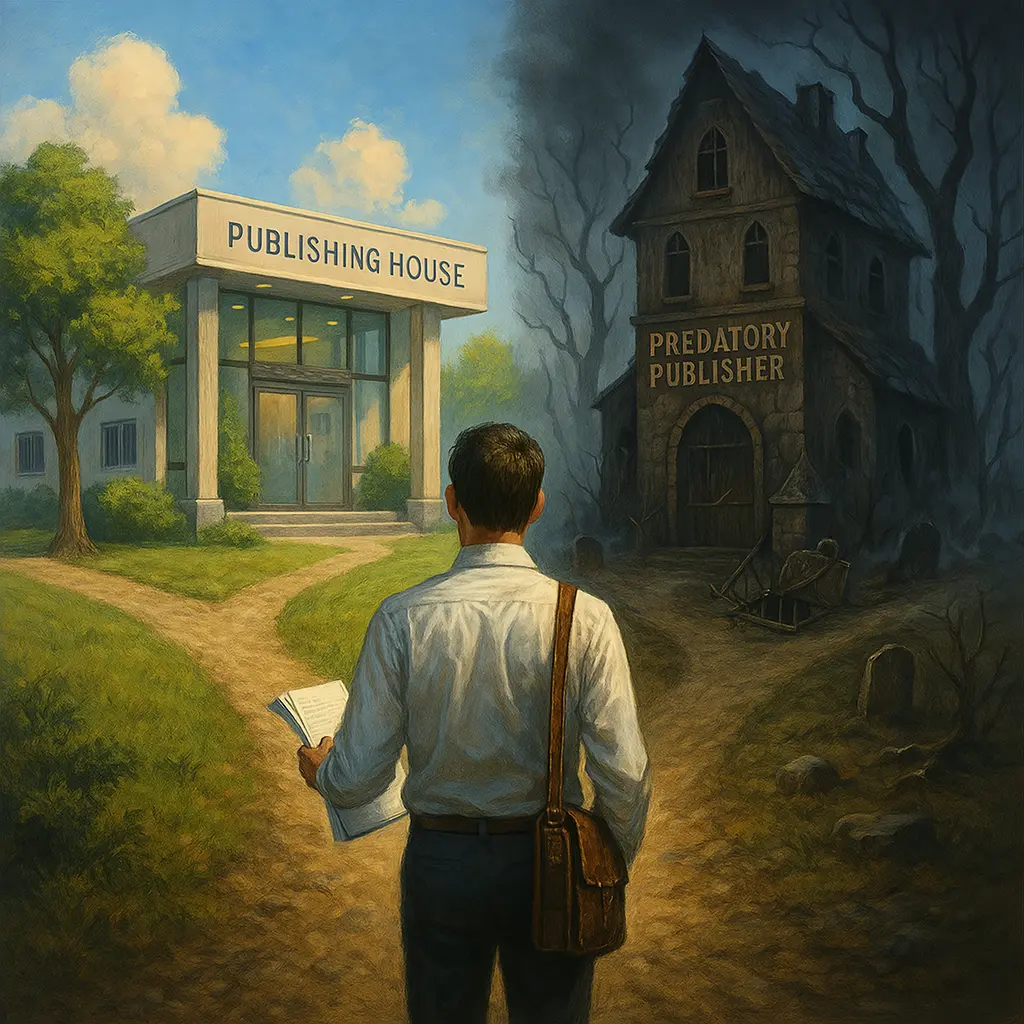
The rise of Open Access (OA) publishing has given a major opening for predatory publishers to target susceptible victims. Many reputable OA book publishers come with author processing charges (APCs) upon acceptance and publication in order to pay for essential processing services involving peer review and composition costs. Predatory publishers use this to their advantage by charging similar fees but not providing any of the peer review services that the fees are supposed to cover. Due to the similarity in fees being charged, it becomes quite difficult for authors, especially early career researchers, to distinguish between legitimate publishers and those that are scams.
To assist authors, publishers and professionals have worked to create ways to assist researchers when deciding where to publish. The website Think. Check. Submit is a site that offers authors numerous checklists and tools to determine which publishers are trusted and which are predatory. For book authors, their checklist for books and chapters is particularly helpful as it can help authors to find information on publisher websites about the offering of services to authors such as indexing and archiving, which most predatory publishers do not offer. It also provides a list of societies and ethics groups with which most reputable journals are partnered. This checklist along with most others on the Think. Check. Submit website is currently available in 27 different languages to help authors on a global scale.
As most predatory publishers dangle the promise of open access publishing as an enticement for potential authors, the Directory of Open Access Books (DOAB) is another helpful resource for authors. Per their website, “DOAB is a community-driven discovery service that indexes and provides access to scholarly, peer-reviewed open access books and helps users to find trusted open access book publishers. All DOAB services are free of
charge and all data is freely available.” DOAB’s website is searchable by book title, publisher, subject matter, and language allowing authors to search for a publisher to determine whether a publishing company has properly indexed titles, which can go a long way in helping to avoid illegitimate publishing groups.
DOAB is rigorous in the way in which they index books in their directory. Every book to be included in the directory must carry an open license and have undergone external peer review. Additionally, all books must be in a prescribed definition of a long-form academic format (i.e., a monograph, edited collection, or book chapter). DOAB website also has specific criteria for the peer review processing of books, and the editorial and peer review process of the journal must be clearly stated on their website and a process for handling conflicts of interest must also be outlined on the publisher’s website.
DOAB’s job has not been easy as OA book publishing has grown dramatically in the last decade. The OA book market is particularly large in Europe, North America, and Latin America. As a result of the growing number of OA books flooding the scholarly publishing market, the group has moved toward a model of targeting book publishers and publishing societies for evaluation instead of evaluating individual published books for their directory. This is designed to maintain the platform’s sustainability.
The rise of OA publishing has opened up a Pandora’s Box regarding predatory publishing. While we have seen numerous predatory groups scam authors and researchers out of money with the promise of reputable publication only to provide no indexing and archiving, there are a growing number of groups working to help authors identify legitimate publishers for the submission of their work. Book publishing must be thought of in the same way as journal publishing and scam publishers need to be sniffed out in both in order to maintain academic integrity.
By Chris Moffitt
Chris is a Managing Editor at Technica Editorial