The peer review landscape in scholarly publishing is rapidly changing. As the pressure to publish and the number of reputable scholarly journals both increase, it means competent peer reviewers are being stretched increasingly thin. As a result, this is leading to “reviewer fatigue”—that is, peer reviewers running out of time and energy to submit well-crafted reports—at unprecedented levels. This is especially true in the post-COVID era, because attitudes toward work/life balance have shifted, meaning more would-be reviewers are placing a higher priority on setting aside time for family matters and pastimes outside of work.
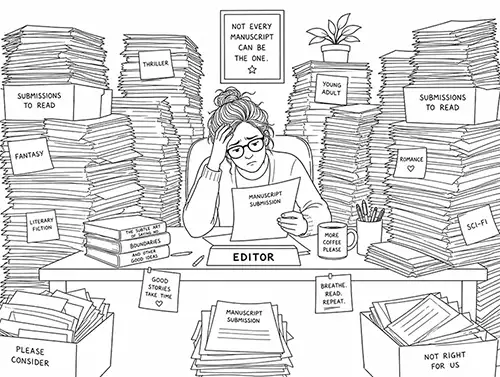
The unfortunate consequence is that the current pace of peer review is slowing, preventing significant amounts of quality research from being published in a timely manner—and experts agree that something needs to be done.
In order to keep up with these changes, scholarly journal editors and publishers must modify their peer review workflows. The first step is to understand why, exactly, submission volume is increasing, and thus, why reviewer fatigue is spiking so dramatically. The reasons can be divided into three overarching categories: more authors seeking publication, more scholarly journal options, and increasing pressure on both authors and journals to maintain their submission statistics in the age of technology.
…Those are the problems. What are the solutions?
The answer to this question is much more complex, because different potential answers are being proposed and tested every day, some with much more success than others. But a strong argument is currently being made for two main changes to the system, both of which can take numerous forms: enlisting the help of AEs and editorial boards, and modifying how peer reviewers are recruited.
Three Reasons Why Submission Volume Is Increasing
1. More authors seeking publication.
2. More journal options. A generation ago, when journals were primarily in print (and, thus, expensive to produce, due to paper and ink costs), each scientific sector had far fewer prestigious journals for authors to choose from when deciding where to submit their work. Today, with the widespread adoption of digital publishing, the number of journals has grown dramatically.
Adding to this dramatic spike is the increasingly popular trend of “offshoot” journals that represent a smaller subset of a larger sector. For example, a large, flagship journal might focus on marine life in a particular geographic area, whereas a smaller offshoot journal, perhaps, is devoted to just certain species of marine life in that same area. This inherently creates more options for would-be authors (especially because editors of one journal within a family might recommend submission to another), and thus more submissions come through the pipeline.
3. In the age of technology, submission statistics are becoming more visible. When journals receive a high number of submissions, they might become more prestigious, because this indicates that they are more sought after. And as technology advances, journal statistics are easier to obtain; all it takes is a five-second Google search.
The same is true for authors. When authors submit work—and their work is accepted—the acceptance boosts their visibility and credibility within their niche communities. And in the highly competitive realm of scientific and scholarly writing and research, it is critical for authors to make their names known to stand out and distinguish themselves.
This is, to some extent, nothing new—name recognition has always been crucial for scholarly authors. But with internet-based work it is becoming the norm—especially in the age of AI—having a visible name is more important than ever. This is driving authors to submit articles to journals in record numbers, and unfortunately, it’s not always easy for those journals to keep up.
…Not easy, but still possible.
Two Ways Journals Can Keep Up
1. Use of AI to identify out-of-scope manuscripts. AI never has been, and never will be, a substitute for human peer reviewers. Still, it can be an effective tool for desk-rejecting manuscripts that are either clearly out of scope or lack the level of novelty a journal is looking for.
AI can, for instance,scan a manuscript for key words and phrases that indicate a manuscript is at least somewhat related to a journal’s subject matter. Those manuscripts that don’t include enough of that vocabulary can then be automatically marked for desk rejection, without peer reviewers spending time and resources evaluating them. Moreover, AI has the ability to quickly search existing literature—and compare it to the points made in a manuscript—to determine whether enough novelty exists to at least merit peer review. If the answer is no, again, the decision to desk reject can come quickly and without review, eliminating the use of a reviewer resource.
There is, of course, a delicate balancing act between effectively using AI to expedite peer review and allowing AI to replace human reviewers altogether. Currently, many journals have policies in place against the latter. So, whenever editors do enlist the help of AI, they must pay close attention to their journals’ regulations on AI usage, just as authors must carefully heed what is and is not acceptable in terms of using AI to write their manuscripts. When appropriately utilized, though, AI has the potential to ease significant peer review burdens.
2. Changes in the peer reviewer recruitment process. When looking for potential peer reviewers to evaluate an article, many editors rely on their own personal contacts, suggestions from colleagues, and reviewer selection programs. To keep up with the growing demand for effective peer review, editors must broaden their scope, potentially reaching out to, for example, editorial boards, retired experts or grad students.
Another issue is whether the review should be double-blind—that is, whether both the author and the reviewer should be unknown to each other. Some reviewers might be less willing to evaluate a scholarly article if they don’t know the authors’ identities. This means editors may need to re-think whether to ask reviewers for assistance on a double-blind basis, instead opting for a single-blind approach (where only the reviewer is unknown to the author, not the other way around).
Moreover, many editors prefer to reach out to reviewers who have expertise in both the experimental and research aspects of the article’s topic; this might narrow the pool too much. Editors may need to look at reviewers who specialize in either experiments or research, so that the few who specialize in both are not stretched too thin.
What’s Next?
The aforementioned ideas offer potential solutions to the growing problem of an excess of submissions and too few reviewers. In the coming years, it will be important for journal publishers not to delay adopting these strategies, because the consensus is that peer review, while far from perfectly systematic, still serves a critical purpose in ensuring that only the soundest research is published.
But perhaps the most controversial question is: Will paying reviewers help ease the burden?
Proponents of this idea argue that peer reviewers will be more likely to invest their time in reviewing tasks if they are getting some kind of financial compensation for it; and a small number of scholarly journals have even experimented with offering salaries for review services. Yet the general consensus seems to remain largely the same, at least for now: payment will not only fail to solve the underlying problem but also ruin the spirit of what peer review was meant to be.
Right now, the prevailing view in scholarly publishing is that paying reviewers would inherently shift the focus from ethics to money. But it remains to be seen whether this opinion will continue to prevail, or if further evolution—such as the advancement of AI and establishment of more high-caliber journals, among other factors—will change this attitude; time will tell!
By Anne Brenner