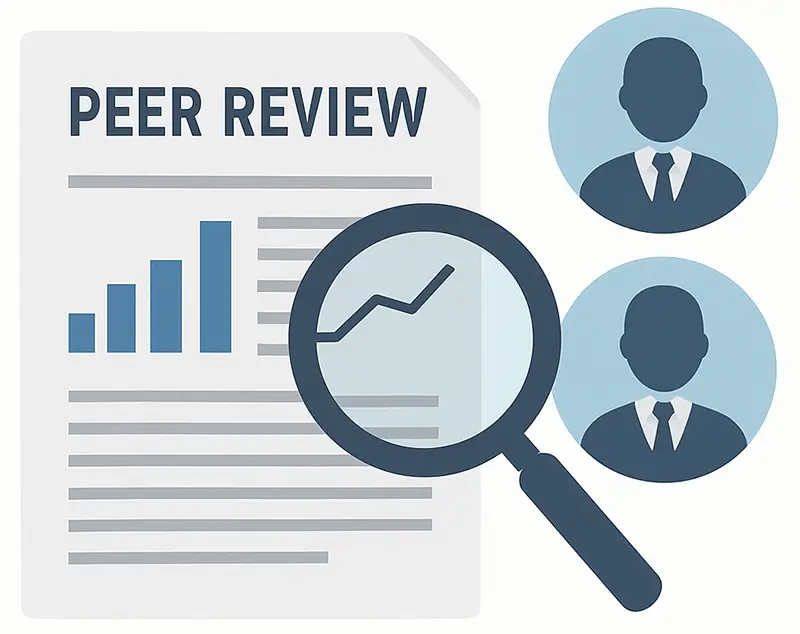
In its simplest terms, peer review is the process by which subject matter experts critique scholarly work—whether an article or book chapter—to assist the editor in determining whether it merits publication. But the benefits of peer review go far beyond this. They reach not only the scientific publishing community as a whole, but also both the author’s and the reviewer’s personal and professional goals.
Still, peer review isn’t without its flaws. Even so, though, those potential pitfalls do have manageable solutions—and the benefits outweigh the risks by far!
How Does the Scientific Community Benefit?
Scientific writing is constantly changing—at least by the year, but some might even go as far as to say by the minute! It’s often totally impossible for an editor to stay completely on top of every single change that might impact the accuracy, timeliness, and relevance of an author’s submitted work. So, that’s where seasoned peer-review experts come into play!
Peer reviewers can give competent opinions as to whether a manuscript’s subject matter is worthy of publication at a particular time. This plays a crucial role in keeping scholarly bodies of literature up-to-date, without factual error, and focused on only the most important and timely topics.
Moreover, by choosing the most competent and knowledgeable peer reviewers for their authors, editors are also helping to maintain the prestige and impact of their own journals. High-quality submissions tend to bolster a journal’s name among the scholarly community—this, in turn, attracts more top-notch authors and additional high-quality submissions.
How Does the Author Benefit?
Some might argue that the benefits of peer review for the author are even greater than those for the scientific community. One of the most critical steps for an up-and-coming author to sustain long-term success is learning how to accept—and learn from—constructive criticism, which is the main point of the peer-review process.
If an author’s work is ultimately rejected, the easy way out is to see it as a failure. Peer review, though, allows the author to take the much more productive path of learning from their mistakes. Figuring out what went wrong is an author’s first major step in setting up the best odds for success going forward. Maybe the research was flawed, or maybe scientific experiments weren’t carried out with the correct approach. Or, maybe translating those experiments to writing just didn’t work out the way it was supposed to, due to grammar errors, poorly organized thoughts, or a combination of both. A peer reviewer can help the author pinpoint what the problems might have been, thus encouraging a “learn for next time” attitude.
But even if the author’s work does eventually make it to the publication floor, constructive criticism—and responding to it respectfully and thoughtfully—is still half the battle. This often takes the form of authors writing response/rebuttal letters to peer reviewers’ comments prior to making revisions. This process fosters a professional and educational relationship between the author and the reviewer, and it gives authors a meaningful outlet to work toward improvement.
Authors might also use peer-review feedback to help each other. Student authors in particular can share that peer-review feedback with their classmates (whether the submission was successful or not) as teaching tools within an academic setting. Professors might even be able to formulate entire lesson plans around peer-review feedback that one or more students may have received from a submission. This encourages camaraderie during the learning process for authors and their educators alike!
How Does the Reviewer Benefit?
Oftentimes, because reviewers are prestigious subject matter experts, they have very busy workloads—and, thus, their time for taking reviewing assignments is limited at best. Still, though, peer reviewers should not overlook the perks not only for the authors and the community, but also for themselves!
For one thing, regardless of how many years of experience a peer reviewer might have, the importance of keeping one’s resume up-to-date can’t ever be underestimated, particularly in an area like scholarly publishing that is constantly changing. Furthermore, along those same lines, peer reviewers can use recent assignments to prepare ideas for presentations at conferences and networking events. This helps them maintain their reputation and name within the seasoned members of their field, and it also helps them publicize that name for newer members of that field.
In addition, peer review is most often done without any kind of monetary compensation for the peer reviewer. This helps others within the community to know, without a doubt, that the reviewer is taking on the assignment for all of the right reasons and without ulterior motives—a critical step in establishing trust with authors and editors alike.
What Are the Possible Problems?
Despite all of its productive benefits, peer review does also come with potential risks—and arguably, the biggest one is room for bias.
Every effort might be made to eliminate bias. This might happen through concealing the identity of the reviewer to the author (known as a “single blind” process) or even concealing both the author’s and the reviewer’s identities from each other (known as a “double blind” process). But unfortunately, bias sometimes just finds a way of creeping into the picture.
This, however, is where maintaining professional standards becomes paramount. Editors can, and should, consult with each other to make sure they are choosing reviewers who are most appropriate for a particular author’s scholarly work, and who are least likely to introduce bias, whether intentionally or not.
Likewise, reviewers should utilize a self-screening process. Before agreeing to review a particular scholarly manuscript or chapter by a particular author, a peer reviewer must carefully screen all potential assignments for possible conflicts of interest (COI). Saying “no” to an assignment due to COI isn’t a sign of laziness or unprofessionalism—rather, it demonstrates character and desire to keep the peer-review workflow as ethically sound as possible.
Moreover, availability—or lack thereof—can sometimes cause dilemmas. This is particularly true if a submission pertains to an area of expertise in science or medicine that’s limited to a very small group of subject matter experts. If one or two top peer reviewers aren’t available at a particular time, it can be difficult to find someone who has the ability to effectively critique the work. This might cause the peer-review process to stretch out over weeks or even months—and by the time it comes to an end, the work of the author in question might be rendered inaccurate due to changes in the field that have occurred in the interim.
But editors can certainly plan ahead for this possibility. This might mean doing thorough research as to the top minds for a given manuscript’s topic, and having multiple possibilities in place for peer reviewers, just in case one or two are forced to decline the assignment. Balancing timeliness with this process can be a fine tightrope to walk, especially if the field in question is rapidly evolving. Again, editors consulting and collaborating with each other—and jointly coming up with plans to balance things out accordingly—is an effective strategy in mitigating this.
Final Thoughts
While certainly not perfect, peer review is instrumental in maintaining high-quality standards in the scholarly publishing field. But perhaps even more important is its role in helping authors identify and correct any weaknesses in their work. Peer review, in essence, creates a mutually beneficial relationship between authors, editors, reviewers, and the scholarly community at large—and that’s what the publishing world should be all about!
By Anne Brenner
Anne is an Assistant Managing Editor at Technica Editorial