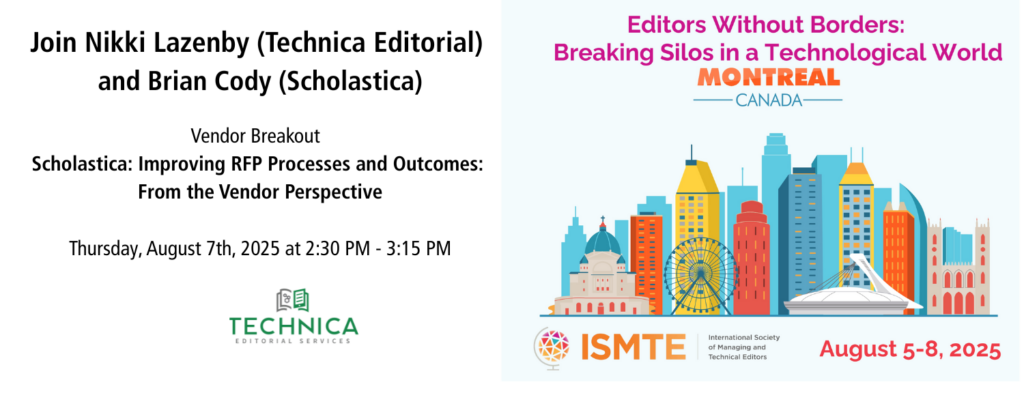
I had the pleasure of recently attending and presenting at the ISMTE 2025 North American Annual Conference — Editors Without Borders: Breaking Silos in a Technological World. The conference took place August 5–8, 2025 in Montréal, a melting pot of a city emblematic of the conference’s goal: making academic research accessible to a diverse group of people.
The conference was admirable in its intention to prioritize the health and wellness of attendees with extended wellness breaks throughout, daily physical activity tai chi sessions, and a consistently available Meditation-Prayer Room for times when a quieter moment was needed.
Of particular interest was Thursday morning’s plenary session: Global Shifts, Local Impact: Navigating Change in Scholarly Publishing. The passion of the presenters and attendees in protecting scientific integrity shone brightly through in this session. The main topic of discussion was the general population’s eroding trust in science. As members of the academic publishing community, we are acutely aware of the time and passion that goes into not only performing the research but also preparing submissions to meet the approval of reviewers in the industry and ultimately be published for dissemination. But what responsibility do we have to help the public find this information — and how do we do it?
It was suggested that it is the responsibility of the academic publishing community to meet the public where they are. General readers are likely not seeking out academically published information. So how do we get the science to them? Several publishers have implemented plain language summaries that are freely available alongside the publication. But is it enough? I particularly found the idea of scientific “influencers” as a means to distribute these plain language summaries via avenues where the general public is likely to be worth further exploring.
Continuing the theme of taking pride in the publications we support, I also greatly enjoyed the Reporting and Data Analysis breakout session where presenters discussed the metrics that are crucial for regularly monitoring your journals to ensure their health. But the data at face value isn’t enough. True crime fans unite: Sleuthing out the “why” behind the data trends is just as important, if not more so, than having the data themselves, as they write the story of your journal.
I had the pleasure of wrapping up the sessions on the conference’s third day alongside Brian Cody, CEO and Co-Founder at Scholastica, in our presentation, “Improving RFP Processes and Outcomes: From the Vendor Perspective.” As we both have nearly two decades of experience in sifting through the Request for Proposals process, there was no lack of case studies to discuss. In this way, we highlighted approaches publishers can take to write RFPs that ultimately get them better, more relevant proposals back in response. Structured as the personality types to which RFPs tend to conform, we discussed the do’s and don’ts of a great RFP. For instance,
· DO: be clear and transparent in the “why” behind issuing the RFP and the selection criteria behind selecting a new vendor.
· DON’T: overly share restrictive requirements that do not leave room for a vendor to suggest improvements or discuss their own qualifications.
Keep your eyes peeled for a forthcoming blog post on more specifics of writing a successful RFP.
All in all, I find the ISMTE conference to consistently be one of the most thoughtfully planned and engaging conferences within the scholarly publishing industry. I look forward to watching how it continues to grow and engage the community!
By Nikki Lazenby
Nikki is an Associate Director at Technica Editorial