Why Print Books Still Matter
A generation ago, when an author was ready to take a book to print, the meaning of doing this was, quite literally, going “to print”—that is, making the book into a print copy.
In today’s world, though, things are much more complicated than that. With the increase in popularity of ebooks, authors now face a crucial choice right before publication: Does the book get published in traditional print format, in ebook format, or both?
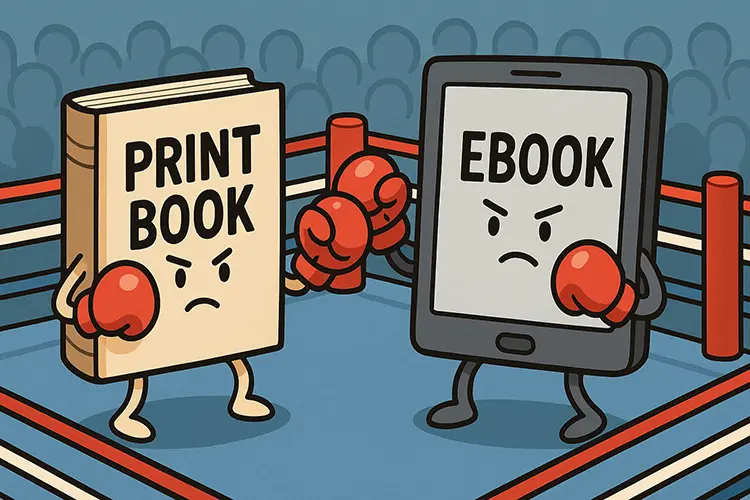
The answer to this question depends on numerous different factors. Whether an author makes the right call could ultimately make or break the book’s sales and profits. But with a little planning and self-education about the current atmosphere, authors can easily make the choice that will set them up for success!
The factors to consider can, in their most basic form, be divided into three main groups:
- Audience and demographic. Who, exactly, is the book being written for?
- Cost. What kind of budget is an author on, and what aspects of the book are most crucial when considering that budget?
- Subject matter. What type of medium is best suited to the topic(s) of the book?
In Part I of this two-part series, we will delve into some of the different reasons why authors might go with the more traditional print format, using these three overarching factors as a guide:
Which Audiences Might Prefer Print?
Oftentimes, older generations prefer print books over ebooks, because they might not be as familiar with the technology that is necessary to read ebooks. Moreover, those in environments where that technology isn’t readily available, such as developing countries, might not have the needed tools to read an ebook. So, if the target audience is one of those two groups, print might be the way to go.
Another issue worth considering is whether the book is primarily intended for solo readers or to be read as a group, such as an academic textbook designed for use in a classroom setting. If it’s the latter, print might also be the more efficient option. Realistically, technology snafus do happen. So, if the idea is to (quite literally) get everyone in the room on the same page at the same time, opening up a print copy could be much quicker and easier than trying to wait for everyone’s computer to correctly power on.
On a related note: in the classroom—or for homework assignments—instructors might ask their students to regularly highlight important sections or passages during the reading process. But this definitely isn’t limited to an academic setting; plenty of pleasure readers enjoy doing this to help them get the most out of the content. While highlighting certainly isn’t impossible with digital content, it’s much more complicated than doing it the old-fashioned way: with a yellow marker. So, if the audience is, for any reason, going to be highlighting as they go, the author should seriously consider print as the primary medium, simply for ease-of-use reasons.
Cost Matters
Print books do, admittedly, have higher production costs associated with them than ebooks—this will be discussed in more detail in Part II of this post. But here’s the flip side: readers will always have to purchase some type of digital device before they can even read an ebook in the first place.
The costs and values of digital devices—such as laptops or tablets—will always be quite high, to the tune of hundreds (if not thousands) of dollars. Moreover, most of these types of devices aren’t designed to last more than about five years or so, meaning consumers will have to frequently spend the money to replace them.
A print book, on the other hand, will always have a lower retail price for a reader than an expensive digital device needed to read an ebook. A hardcover book, generally speaking, costs about $25, whereas paperback costs $13 or so—a fraction of the cost of a digital device. So, in some cases (depending, again, on the audience) a print book might actually give an author a better bottom line than anything electronic.
And don’t forget about the option of buying and selling used books. The cost of a used print book will always be significantly lower than the cost of a new one, which creates an attractive option for many readers. As long as it is kept in good condition, a used book can stay in the market for a significant period of time. This can be especially useful in the academia realm, as incoming students, from elementary school all the way up through the university level, are seeking gently used textbooks year after year. By contrast, ebooks can be difficult to resell, especially if licensing restrictions exist, which is far more common in electronic literature than in print literature. This, in turn, could limit bottom line possibilities for the author.
There are obviously other factors that must be considered, such as how much the retailer is willing to pay the publisher, along with the dollar value of royalties paid to an author, based on contractual agreements. These will vary depending on the project, publisher, and current market needs. Nevertheless, a potentially larger audience, and therefore a potentially higher bottom line, will always be something for an author to look at.
What About Topic?
The genre and/or the subject matter of a book can make a substantial difference when it comes to whether print or online mediums would be most appropriate. While the internet can enhance some types of content, it can do a major disservice for others.
Take for instance, a children’s book that contains popup images, designed to give its young readers both a visual and tactile experience. It would be totally impossible to capture this purpose in a computer screen; you need something that can be simultaneously seen and touched. There is simply no substitute for print literature in a situation like this.
By a similar token, consider 3D images. While modern technology does have ways to create this effect to a certain extent, again, it’s not necessarily duplicable without objects that are physically popping out. The topic of a book often dictates how much (if any) 3D imagery is essential to the book’s purpose. So, this is another question for the author to ponder during the early planning stages of the work’s subject matter.
Something else to consider is whether a reader might be engaging in a certain activity while reading the book—and, if so, whether that would be practical with an ebook format. A perfect example might be a cookbook. If a reader is looking at this kind of book, chances are they are doing so while they are trying out a recipe in their kitchen. It might be tough to safely plug in an electronic device while fixing up a recipe. Moreover, it could be equally challenging to quickly and efficiently look up the necessary ingredients or measurements during the busy process of, for instance, baking a cake. That’s something the author should take into account prior to publication; print might be the much better route.
Conclusion and Looking Ahead
Aside from the audience, cost, and subject matter factors, numerous studies have shown that print books are, in many ways, just plain healthier—both for readers and for the environment. They cause less eyestrain, don’t contribute to “screen fatigue,” and are more easily recyclable than their electronic counterparts. Studies have also pointed to printed books as being most effective in allowing readers to comprehend their content, providing an advantage in scholarly settings and making reading for pleasure more enjoyable. Of course, this doesn’t mean ebooks can’t ever be the better option; they provide their own major advantages in the right time and place. Part II of this post will focus on those occasions when choosing an electronic medium is the best course of action for an author to take!
Click here to view Part Two of this series.
By Anne Brenner
Anne is an Assistant Managing Editor at Technica Editorial