Genre as the key to fully comprehending fiction reading and publishing alike.
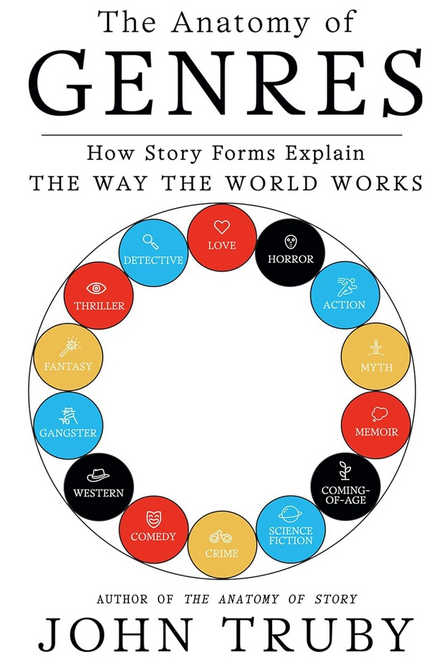
Any writer looking to professionally publish their work requires a certain knowledge of publishing as an industry. Editors and executives look at what they can have the most luck selling to customers, and that involves marketing books as products that can be categorized. A story’s genre significantly influences book marketing and publishing; understanding how genre functions will enable authors to succeed. John Truby’s The Anatomy of Genres: How Story Forms Explain the Way the World Works is an excellent exploration of genres of all categories, subcategories, themes, and meanings for writers, readers, and viewers alike.
The book lists twelve main genres: horror, action, myth, memoir/coming-of-age, science fiction, crime, comedy, Western, gangster, fantasy, detective/thriller, and love stories. A major theme/ideology is discussed for each genre, including the traditional “beats” of a story within the genre, how to further explore the genre, and examples of well-executed stories in that genre and its subcategories.
Many people might choose more contemporary stories when it comes to genres such as science fiction. Truby traces the origin of science fiction to earlier texts, with The Tempest being the first science fiction story, with magic simply the substitute for the advanced science that the genre would later be defined by. Many science fiction novels such as Dune are fantasy stories in science fiction clothing, but there are still important distinctions between the two genres, distinctions that are manifested in the wonderous The Tempest. The lead uses his advanced learned abilities to build a new world/“laboratory” that will eventually spread beyond his own “laboratory’s” borders, and controls two fantastical creatures (one of them referred to as a monster), while the story delves into the morality and character development occurring within a strange new world. More modern stories are also described as prime examples of the genre’s offerings, such as Seven Samurai for the action genre: the fight for freedom against overwhelming odds and enslavement.
For a more specific example of the book’s explorations: the “myth” genre. This genre is about the processes of life, manifested as an earlier and cruder form of the drama genre. The temptation to conflate myth with the fantasy genre exists through the fact that myths are set in fantastic worlds ranging from Middle Earth to Gotham City, and many “myth” stories do cross over with fantasy as a genre. But at the core, myths are about viewing life as a journey and/or search for meaning; the physical journey is linked to some sort of internal journey and rebirth. And that is only the beginning of what this one genre is capable of exploring and enlightening, and just one out of the many genres the book uses.
It would be wrong to view genre as a limitation on a work’s potential, even considering the various subgenres that allow for more precise specification and the fact that most contemporary stories usually mix multiple genres. Several contemporary novels set in a fantasy setting have mixed politics in the story’s plot, and with that, the “Gangster” genre tells the story of power’s rising and falling. In many horror stories, characters’ choices to help overcome their fears synch with the beats of the coming-of-age genre. Action comedies are especially popular with movie audiences as they combine a sense of spectacle and tension with a warmer underbelly of humanity and “morality’s” quirks and shades. These mixes, and so many others, create a much greater potential for a story’s originality and the ability to captivate an audience.
Writers should avoid letting genre limit their creativity and refrain from following conventional stereotypical story beats. A (too) often-used romance plot is a heterosexual squabbling-to-romance storyline. When writers such as Shakespeare and Austen have used it extremely successfully, it’s easy to see the temptation for others to use it as a seemingly exciting story or an easy selling point. But, rather than play by the rules, a writer can avoid stale clichés even with certain standard conventions: changing how the story beats happen (instead of a conveniently dramatic misunderstanding, a striking revelation can inspire character development that exacerbates tension); expressing a genre’s philosophy through the story’s theme (rather than hate and love are two different sides of passion, maturity can help create affection through new self-understandings); exploring a genre’s specific story forms of life (the quest for happiness comes not through prolonged conflict but by the determination to cooperate that leads to a positive resolution).
A particularly interesting possibility listed by the author as a way to transcend genre is the anti-Western story form as an offspring of the Western. The main theme behind a Western is the supposed rise and fall of civilization with the ethics of individualism and freedom and finding the promised land within the wild. When space became the new final frontier, the crossover subgenre of “Space Westerns” arose. But the anti-Western operates as the downfall of the supposed West, the society challenging and eventually crushing the individual. This subgenre flips the main beats of the Western on its head, from showdown to massacre, from self-revelation to inevitable defeat.
The book does not stoop to teach a lesson on how to write a “perfect” novel that will hook all readers, publishers, and buyers alike. Rather, Truby guides us to see patterns in the world of stories that help build traditions, narratives, and a fully immersive experience. Whether for personal discoveries or professional usage, The Anatomy of Genres provides a significant and thorough look into an essential piece of storytelling and publishing.
By Grace Dietz
Grace is an Editorial Assistant at Technica Editorial