Mixing business, personal or professional, with pleasure has never been so easy.
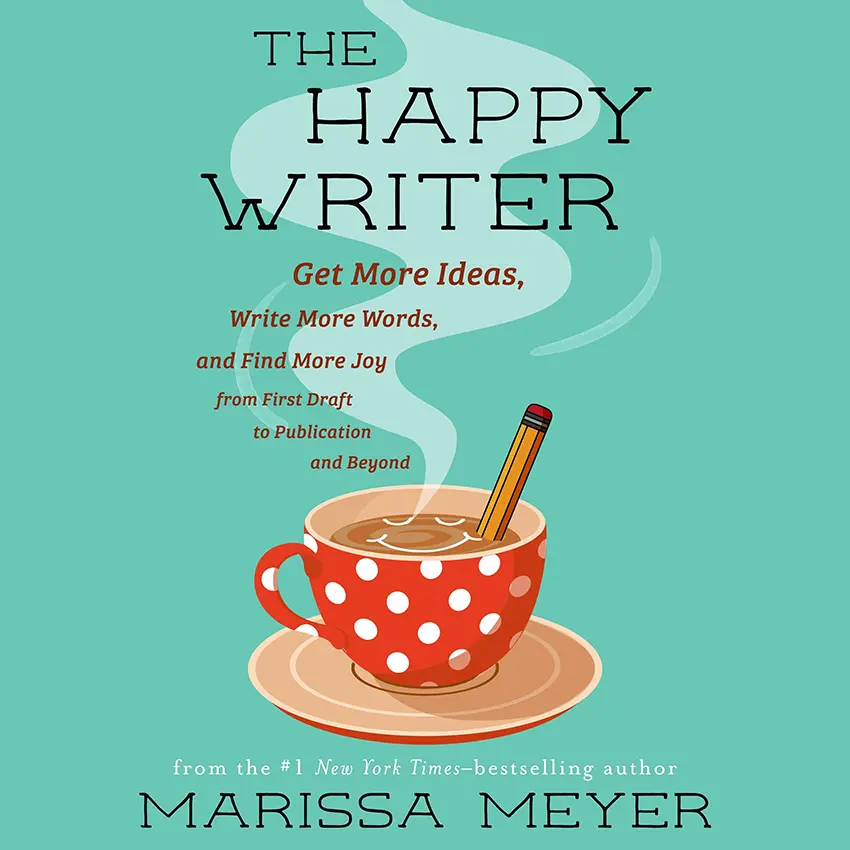
Writing is to some degree associated with stress, especially for those who consider it to be just the same as any “regular” job: demanding, with no guarantee of success, a struggle with proper productivity. The phrase “starving artist” helps feed into the idea that there is no creation without fear and struggle, and that in fact a certain amount of that is necessary to provide true inspiration. The Happy Writer: Get More Ideas, Write More Words, and Find More Joy from First Draft to Publication and Beyondis a refreshing antidote to that toxic mindset, as bestselling fiction writer Marissa Meyer converts several experiences of her own into a guidebook worth following.
The first change that needs to be made is a change of mind: if creativity equals happiness, then being creative should mean being happy. Keeping on that train of happiness in other aspects of life can take a variety of forms, whether starting a Someday List, fostering and following curiosities, spending time in nature, stepping outside the comfort zone (casual and creative), and more. Staying inspired too is important to maintain energy and keep story prompts and paths focused on the things that will keep you passionate and in the mood for writing; try creating an inspiration list of topics and an inspiration board of related visuals. And, of course, keep brainstorming!
It’s easy to get distracted from writing when the main medium for writing—typing on a computer—offers several other things to do with just a few clicks. Writing by hand might be slower and physically hard compared to typing, but it’s worth the effort if it means greater productivity. This doesn’t mean writing everything in a story by hand necessarily; it can mean drafting some parts of a story in a notebook (try and make sure the notebook itself doesn’t offer opportunities of further distraction, and that the pen/pencil itself is comfortable), brainstorming, blocking out sequences, etc.
Holding onto ideas, keeping track of the notes, is a good idea, whether it’s for a later date or the inspiration that demands instant action. And if it is the latter, then using the inspiration to ride on a wave of energetic productivity, whether for the new project or a current one, is the right idea. Some ideas, perhaps even most ideas, are better executed after having simmered; not all ideas are good ones, some need more outlining and research, and some lose their appeal over time. But it’s good to keep track of all new ideas, and then, when working on them, why this idea is the one in progress.
Some writers prefer the structured/outlined approach to writing; others prefer the unexpected write-what-feels-right approach. Those lines can blur, as outlines change all the time and there’s often some kind of goal or plot points in mind when writing along. But there doesn’t need to be a specific approach that works best, only the one that works in providing less stress and more joy. For those who seek to outline, getting organized, pulling together all the ideas that currently exist for the project, is the first step. There are plenty of story structure methods, and plenty of ways to use them, the best way being the one that’s the least intimidating.
“Done is good” – having something concrete finished is better than constantly worrying whether a first draft is perfect. The perfection comes later; what matters in the moment is progress. This applies to the pre-writing process as well; it’s good to have a certain amount of background, whether research or story structure, already at the ready to have shaped the mindset when going into the story, but it’s easy to drown in overdetailing for something that hasn’t even been written yet. Corrections can come later.
The same corrections are needed for every book, but some recommended steps are: cut whatever isn’t actively aiding the story (and if it feels too bad to delete too much text, save the cut sections separately as a just-in-case), mark areas of the manuscript that need fixing or strengthening, consider and find ways to improve the most significant story aspects, finish the research that needs finishing, fixing the inconsistencies, and more. One chapter at a time, one element at a time. And love the journey of writing, no matter professional or personal.
Meyer was definitely writing from a happy and fulfilled heart with The Happy Writer, and that affection and drive will be contagious to any would-be writer that seeks to learn how to get better at getting better at their craft. Some tips and tricks are better suited for some than others, and that’s completely okay, as the book makes clear. But by the end of the book, the writer will be cleared for launch with a clearer and more prepared mindset than before.
Other tidbits:
Setting writing goals can also be important; if it feels impossible to finish writing an entire chapter in a day, settle for at least five pages, and if you can write more, do. Having personal arranged time slots can give a greater sense of discipline: if you know that at 7pm after a workday and having dinner you’ll be too tired as a rule to work, then try writing on the weekend. And although a routine can certainly help establish a personal sense of progress, the muses will not sweep in for the kill if you take a couple days to yourself. It’s important to feel like a writer, not a machine or creative but lazy. Every bit of progress writing is more progress than some daydreamers will do…even if the three stories you’ve written haven’t been published, that’s three stories written. The things that don’t work out stand as proof that you’re working rather than just brainstorming.
Not every story that an author feels is in good enough shape to submit will get accepted at the first try or even accepted at all. This is not a sign that you’ll never be good enough, and don’t feel like you must throw everything away relating to that project. Every failure is an opportunity to learn. Maybe one day, years later, you’ll have built up more experience and seen more of the world to get that inspiration that will break whatever stalled the project the first time. Maybe one day, you’ll realize why that story didn’t work out, whether it was a sign of immature prose or flat characterization, and you can instead be grateful that you’re doing a better job now. Maybe one day, you’ll realize that writing this historical fiction novel would have been colossally inappropriately appropriative, but you can be grateful that you saved your notes and research for that project, because now you have that much already built up if you ever want to try writing a different story set during the same time.
By Grace Dietz
Grace is an Editorial Assistant at Technica Editorial