
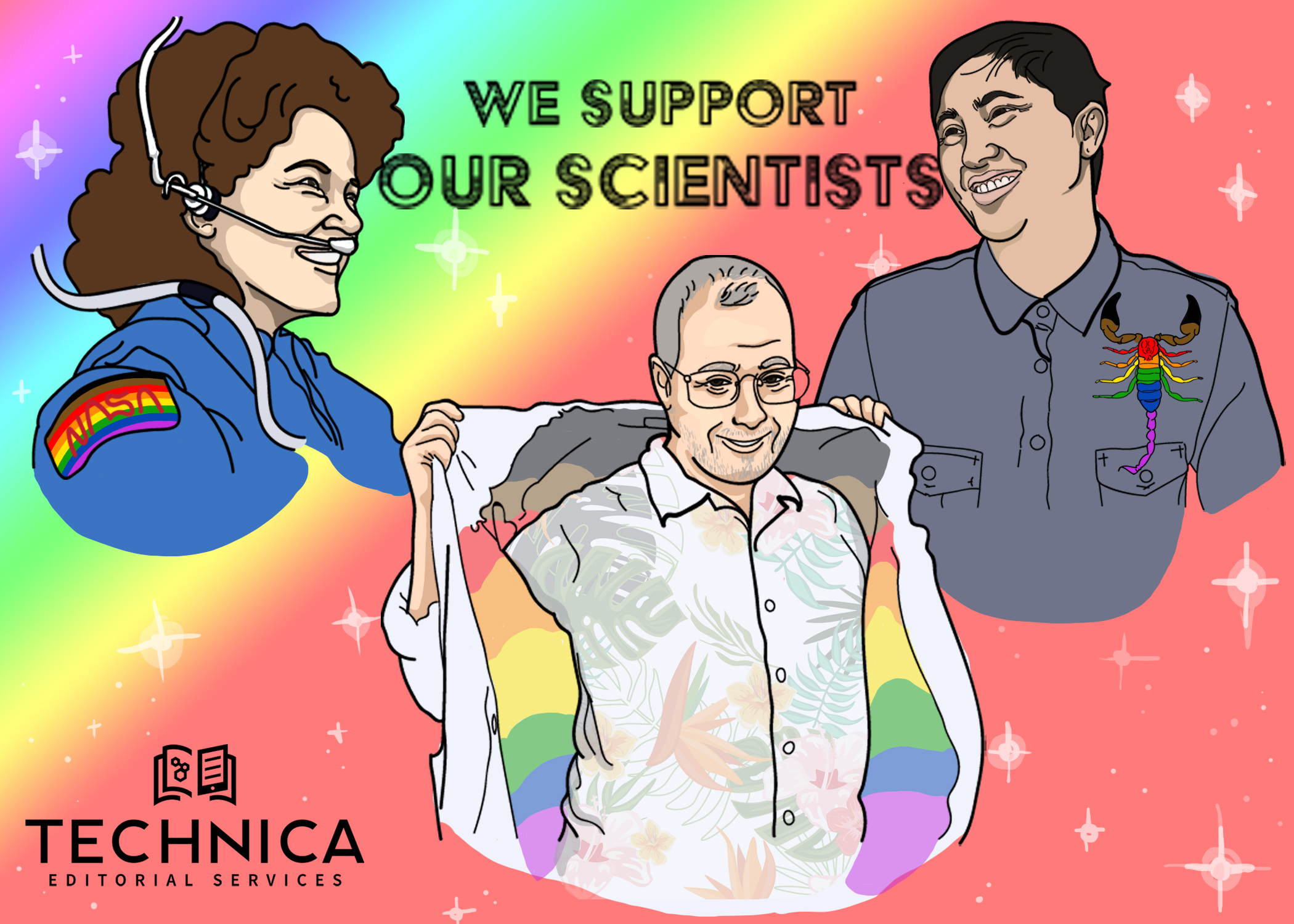
June is nationally recognized as Pride month in the U.S., with celebrations taking place across the country in the form of parades, marches, and vigils. June was chosen in honor of the Stonewall Riots, which took place on June 28th, 1969, at the Stonewall Inn in Greenwich Village, NY. The Stonewall Riots are seen by many historians as the beginning of the gay rights movement. Pride is a time for members of the LGBTQ+ community and allies to be seen and participate in activism. So, in the spirit of Pride, here are a few prominent LGBTQ+ professionals in science.
Dr. Lauren Esposito:
Dr. Lauren Esposito is the assistant curator and Schlinger Chair of arachnology at California Academy of Sciences. Her research focuses on identifying species of scorpions and how they alter the composition of their venom depending on the situation. When asked why she was drawn to scorpions, she said, “Scorpions are the oldest living terrestrial arthropods on the planet. They’re approximately 400 million years old: They were here before dinosaurs, and ever since haven’t changed in their overall form.” Earlier this year, Dr. Esposito was awarded the National Organization of Gay and Lesbian Scientists and Technical Professionals’ 2019 Walt Westman Award for her 500 Queer Scientists campaign. 500 Queer Scientists was started by Esposito in 2018 with the aim of increasing visibility for LGBTQ+ scientists. Scientists self-submit their profiles to the website, enabling them to be visible role models for young LGBTQ+ people interested in STEM.
Dr. Ben Barres:
Ben Barres was a leading neurobiologist at Stanford University until his death in 2017. His groundbreaking research on glial cells, once considered to be relatively unimportant cells, has led to advancements in the treatment brain disorders such as Alzheimer’s and Huntington’s disease. In 1997, Barres came out to his colleagues as transgender. After transitioning from female to male, Barres realized the extent of gender discrimination in science having now lived with and without male privilege. Barres became an advocate for gender equality in science for women and gender non-conforming (GNC) people. Barres’ 2006 article, “Does gender matter?”, debunked Peter Lawrence’s claim that the dearth of women in science was due to the gender’s innate lower aptitude for science. Barres provided data that showing that the real cause was institutional discrimination, not genetic inferiority. His advocacy work for women and GNC people in sciences was as important to him as his lab’s research into the causes of neural tissue degeneration in patients with Alzheimer’s, Parkinson’s, and Huntington’s diseases.
Dr. Sally Ride
Up until 1977, women were not allowed to apply to NASA to be astronauts. Ride was a Ph.D student finishing her degree in physics when she saw that NASA was looking to hire engineers and subsequently submitted her application. In January of 1978, NASA selected Ride along with 6 other women to be in the new class of 35 astronauts. Five years later, Ride became the first American woman and youngest American to go into space; she is also recognized as the first openly gay astronaut. In 1986, she served on the Rogers Commission Report into the Challenger explosion, the same shuttle she had flown on in her two previous missions. After retiring from NASA in 1987, Ride dedicated her life to improving science education for women. She and her partner, Tam O’Shaughnessy, have written several children’s books and co-founded the Sally Ride Science organization aimed at promoting STEM education.