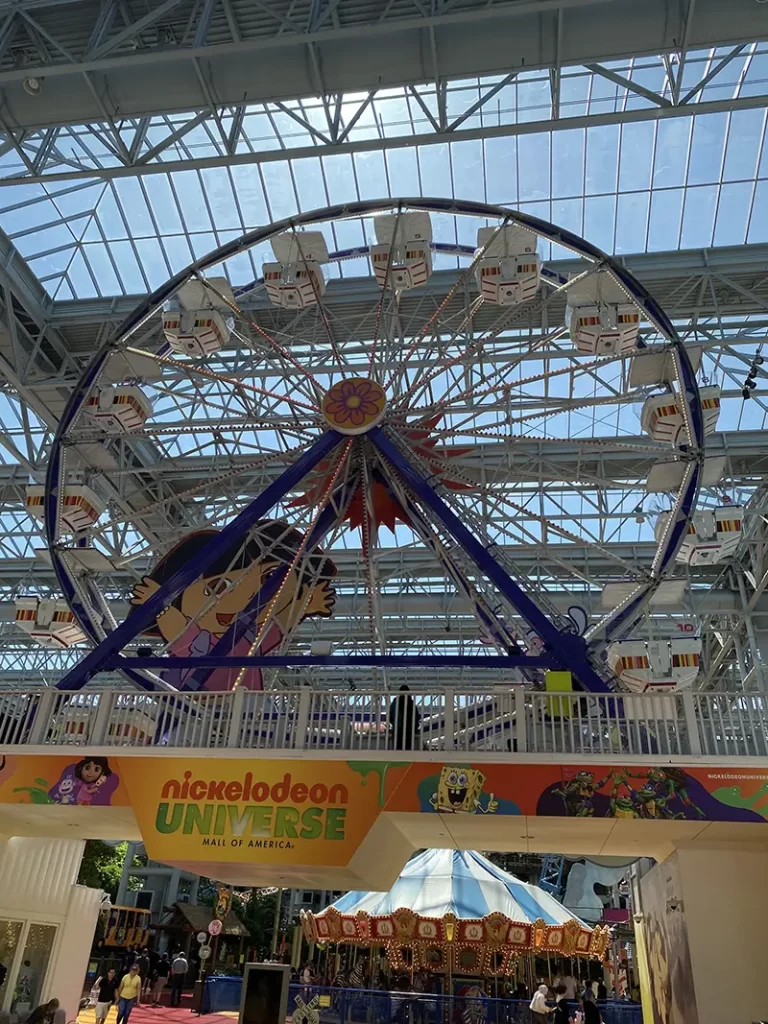
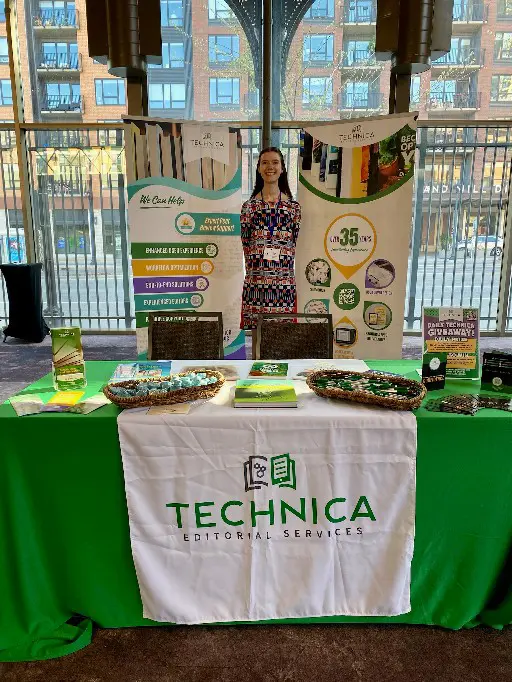
My colleague Nikki Lazenby and I represented Technica Editorial Services at the 2025 annual meeting for the Council of Science Editors (CSE) in Minneapolis, Minnesota. We arrived early after a 6am flight and had some time to see this beautiful city before the welcome reception. So of course, we made our way over to the Mall of America, which boasts an indoor theme park(!) and an entire floor made up solely of restaurants.
We also checked out the sculpture garden—while the famous Spoonbridge and Cherry statue was being repainted, the sunny weather made for an ideal afternoon of walking around to admire the other artwork. Though the sightseeing was lovely (and a lack of humidity to boot, a refreshing change from NC weather!), before I knew it, the conference was time to start! After our table was set up, we greeted everyone who stopped by during the welcome reception.
On Monday morning, the conference began in earnest with a lively musical production titled: “Publish Like It’s 1999! The Ghosts of Publishing Past, Present, and Future Celebrate our Industry.” This is when I learned Prince was born in Minneapolis—every song in the show was a rewritten Prince tunes.
After a quick break, it was time for some continuing education talks—I learned about the importance of building new and ongoing publishing partnerships, the responsibility of data sharing requirements, and strategies for research integrity investigations.
Finally, the last panel of my day ended up being a small-group discussion (less than 10 of us!) about how we got started in scholarly publishing. It was enlightening to hear how the path to this career is not always direct, and sharing stories with the fellow attendees was a wonderful way to end the afternoon.
During the presidential reception, I rejoined Nikki at the table. Later, at a CSE–organized dinner conversation, I walked to a local farm-to-table restaurant with a small group of fellow attendees, where we discussed not only our daily jobs and themes from the conference talks but also what keeps us busy in our daily lives.
On Tuesday morning, a lively Ethics Clinic took place with full audience participation, with a focus on artificial intelligence (AI) and ethics. I then attended a session about how journals are responding to new federal requirements for public access to scientific research—the United States could examine how other countries are mandating the release and access of scientific publications. I also learned about how peer review can be decentralized and some models for open peer review, like forums and preprint servers.
Additionally, another AI–focused session asked if scientific publishing is prepared for the future—those who work in the editorial office can be the ones to make ethical AI policies to navigate future developments in scientific publishing.
The final symposium took place in the main hall, where attendees listened to a panel discuss the future of scientific editing and publishing. The speakers discussed their hopes for change and what is likely to change (or not), keeping in mind that the day-to-day is unpredictable.
Here are a few key takeaways I learned from the CSE conference:
- It is important to reinforce the idea of a cooperative partnership instead of thinking of the society and publisher relationship as solely vendor-client based. The relationship is one that can be harmonious if it is approached like a partnership, as two teams working together toward a common goal—that is, to promote the journal and its research.
- Additionally, for some smaller societies, it may be more logical to self-publish, rather than work with a publisher.
- There is power in human connection—there are some things that computers/AI just can’t do well. Editors and reviewers can assess the novelty of the science—an AI screening tool before editorial/peer review could be useful because it can assess things like the correct format or the hypothesis of the paper and where those are flawed. This reduces the burden on human peer reviewers and editors, who can then focus their attention on the science and whether the work has sufficient novelty.
- Utilize AI as a review assistant tool, not to write the entire review (this would potentially be unethical for many current and future journal AI policies).
- Data sharing is about more than sharing—it’s about data integrity. It was discussed that authors are making errors when sharing their data or lack thereof. Of course, some accidental mistakes are inevitable (we’re only human, after all), but the importance of clear data sharing requirements cannot be overlooked.
- One suggestion was to try recommending data sharing instead of requiring it to introduce the topic, educate the potential authors, and share the benefits. Then, in two to three years, make data sharing a journal requirement.
- A common refrain for data sharing is “open as possible, closed as necessary.”
The 2025 CSE annual meeting was a great experience, and I enjoyed meeting fellow science editors. I’m already looking forward to next year, when the meeting is a little closer to home—in Durham, NC!
By Claire Lee
Claire is a Managing Editor at Technica Editorial