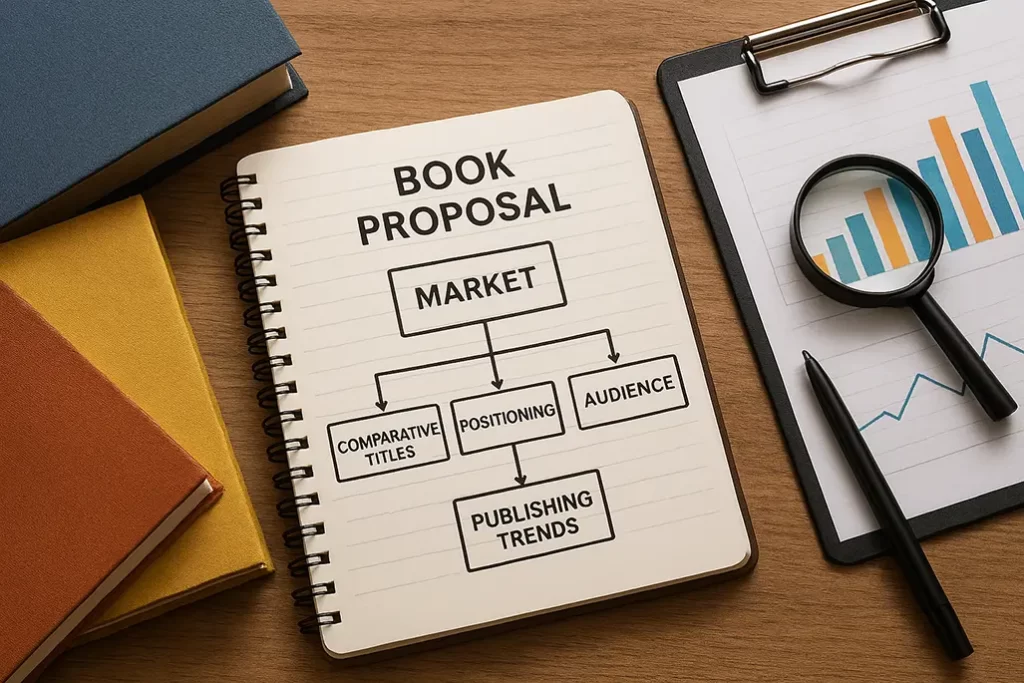
A book proposal is a document that comprehensively lays out a book idea for prospective publishers, thus acting as a business plan for the pitched book. Many non-fiction authors believe the myth that their book proposal must be perfect in order for their manuscript to be accepted by a traditional publisher. However, this is not true. It is more important that you demonstrate market awareness through strong comparative (comp) titles, strategic positioning of your book in the marketplace, audience alignment with your book’s goals, and a clear understanding of publishing trends. Let us look at these strategies in turn to explore how you can set your book up for success without a “perfect” proposal.
Comparative (Comp) Titles
Comparative titles are books that are similar to the book you are writing, and they are used to help editors, agents, and readers comprehend your book’s tone, genre, and potential audience. Comp titles also help agents and editors assess a book’s market potential, understand its potential appeal, and decide whether to acquire the book. An effective way to start researching comp titles is to search for key words related to your book in a trusted search engine. For example, if your book is about organizational leadership, search for these specific words, as well as similar words or phrases such as “leadership structure,” “leaders,” “subordinates,” “teamwork,” “motivation,” and so on. You should also reach out to friends, families, and colleagues to ask if they have read any books with a similar topic, as well as search through bestseller lists for popular books on the topic. Be sure to limit your list of comp titles to 3–5 recently published books, so you provide the publisher with a strong relevant sample of similar books without going on a tangent. When name-checking these comp titles, be sure to tell the publisher what makes your book different from these titles, so you can demonstrate where it fills a gap in the marketplace.
Strategic Positioning in the Marketplace
Strategic positioning describes how authors differentiate their books from those of their competitors, thus creating a unique, valuable title withing the marketplace. By determining what makes your book unique, you have taken the first step to positioning it in the marketplace. You must also decide whether the book is what the marketplace needs right now, as well as what you specifically can bring to the subject through your unique firsthand experiences. You may also wish to align your book with a particular theme—whether societal status and power, financial and material stability, health and physical body, or love and relationships—in order to clarify which readers your book helps and how it helps them navigate their lives. Then you can begin deciding where you want to place your book physically or digitally in bookstores, libraries, and other establishments to reach your target readers and maximize your potential profit. For this step, you may wish to consider asking people and/or organizations to help you market your book to these establishments. If you are self-publishing the book, you should consider releasing it when your audience is most likely to buy it (such as during the holiday season or—if your target audience is students or their parents—during graduation season).
Audience Alignment with Your Book’s Goals
In tandem with positioning your book in the marketplace, you need to sell it to your target audience. Once you understand that target audience, you can try to ensure that your book’s goals align with the target audience’s interests. If you already have a large social media following, you can consider combing those follower lists for potential enthusiastic readers of your book. If you already have an extensive mailing list, you can directly notify these curated readers through an e-mail newsletter, or even a simple, digital advertisement with all the pertinent information—the book’s title, author, release date, publisher (if applicable), a short list of sites where the book is available, and perhaps a mock-up of the book’s cover. However, if you have fewer connections, you should still reach out to those connections and ask them where you might succeed in marketing your book to your ideal target readers. Perhaps there are specialized reading groups at a local university, or you have a connection (even a third connection or higher) who runs an online message board for a specialized organization. For the hypothetical book about organizational leadership introduced in the earlier discussion on comparative titles, it might be a society of entrepreneurs or coalition of related organizations (Entrepreneurs’ Organization, for example).
Understanding Publishing Trends
Since the state of the publishing industry seems to change regularly (with the rise of such developments as search engine optimization, artificial intelligence, audiobook innovations, and more), it has become increasingly important to stay on top of future trends. One of the ways to remain informed about publishing trends is to build a robust author community around yourself, talking to other authors and listening to what is or is not working in regard to publishing success (no matter what the metric). You can build this network in a myriad of ways—getting engaged in Facebook groups or other online communities with authors in your field, attending writers’ conferences, or simply reaching out to individual authors or connections who can introduce you to other authors. The important thing is that your strategy works for you, and that you actively apply it to your writing/publishing career. Another way to remain informed is to listen to podcasts about the publishing industry (especially if they are free, as this will allow you to direct more resources toward producing your book). Ideally, these podcasts will provide you with valuable insights into upcoming trends and how they will impact the industry. If you organize your daily schedule properly, you should find plenty of time to listen to them. A third way to remain informed is to read books about the publishing industry, many of which are short, inexpensive, and easily skimmable while still being helpful. Armed with all this information, you should be well prepared to apply your knowledge of trends to ensure your book is successful in the marketplace.
For further help in optimizing your book for success, check out our free Resources for Authors materials at https://technicaeditorial.com/resources/.
By Matt Wade
Matt is an Editorial Assistant at Technica Editorial