
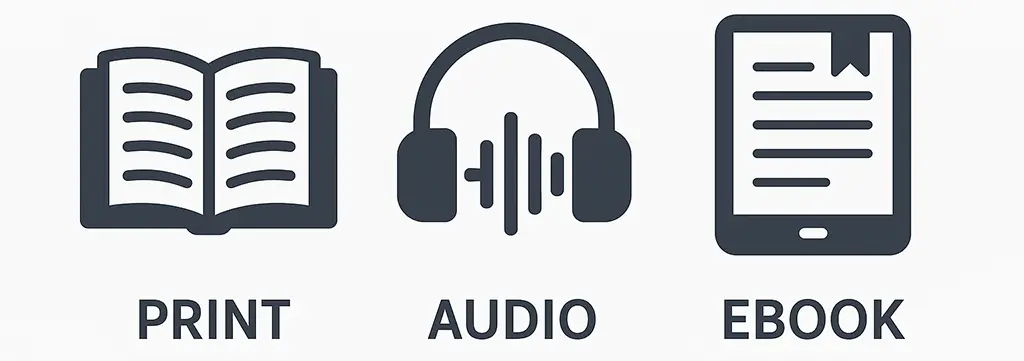
Multi-Format Publishing refers to the accessibility of written content in multiple formats, including print, audio, and eBook formats. It is important to offer multiple formats so you can maximize your potential sales and marketing efforts across all distribution channels. In this article, I will discuss other benefits of multi-format publishing, paying special attention to accessibility for readers.
How Does Multi-Format Publishing Enhance Accessibility?
- Conversion Into a Variety of Formats
Because of e-Publishing, authors can easily convert their written content into a variety of formats, and they can also repurpose the content for distinct types of devices, screens, and reading preferences. Since the content is multi-format, it will work consistently and effortlessly for readers on a variety of operating systems and publishing platforms, further enhancing accessibility.
- Widespread Availability
Digital publishing eliminates geographic barriers, so written content can immediately reach a global audience through different online distribution platforms and devices (tablets, laptops, and mobile devices among others). There are also more eBook titles readily available online than there are print books in bookstores, providing a greater wealth of content for distinct types of readers (including students and researchers alongside casual readers).
- Lower cost
Hardcover and even paperback versions of books can be expensive, so it will be immensely helpful to budget-conscious readers for authors and publishers to offer less expensive eBooks and audiobooks. For international readers, alternative formats also eliminate the need for expensive packaging and postage.
- Interactivity
In the digital realm, authors can add interactive elements like audio, video, animation, and hyperlinks that further immerse readers into the content, enhance reader engagement, and accommodate different learning styles. This is especially useful for non-fiction books for students or researchers, as the index and search systems work very well in e-books. Additionally, metadata enables readers to find authors’ content quickly and easily by searching for the keywords embedded in the content.
- Data Analytics
Data analytics allow authors to collect information about reader preferences, thus allowing them to create targeted marketing campaigns and personalized content for different readers.
- Multiple Formats Accommodate Multiple Preferences
Some readers prefer feeling a paperback or hardcover book in their hands, while others prefer the mobility and ease of use that eBooks or audiobooks provide. By catering to these different preferences, authors broaden their customer base, making their written content accessible to readers who otherwise would not have sought it out. For example, students might have large reading lists that may be difficult to store or carry in hard copy format, so eBooks are more convenient for storing such large libraries (and eBooks are also less expensive for students who are working with a tight budget).
- Enhanced Accessibility for Readers with Disabilities or Different Learning & Reading Needs
The eBook format allows readers to enjoy authors’ written content without having to physically hold a book, if they are not able to due to paralysis, hand deformation, or other maladies (or do not have the time or inclination to sit down and enjoy a physical copy). These publications can also incorporate videos with captions that can aid hearing-impaired readers. Furthermore (unlike with print editions of written content), screen readers, magnifier tools, and other assistive technology (such as closed captions or transcripts for videos) are readily available for electronic content and can quickly deliver and interpret the content’s information to the impaired reader. Screen-reading software can offer options such as text-to-speech or Braille. Electronic content can also benefit visually impaired readers if it incorporates descriptive alternative text (particularly for images such as artwork and photographs) and descriptive links to related content (so customers using screen readers can comprehend the purpose of a link without looking at the link text), along with capabilities such as text resizing and adaptable layouts.
Likewise, audiobooks allow visually impaired readers to enjoy the written content, unaided by Braille, large-print editions, or other accommodations that are not always available. Audiobooks enable new readers (such as elementary school students) to enjoy the content, along with customers who learn better through auditory engagement. This format is even more beneficial for illiterate customers or those with reading disabilities such as dyslexia. On a more practical level, audiobooks allow readers to enjoy books while their hands are engaged in other activities, such as driving or exercising.
Regardless of format, accessible content ensures compliance with the American with Disabilities Act (ADA), European Accessibility Act, Web Content Accessibility Guidelines (WCAG), and other global legal standards, so publishers can avoid fines and reputation harm while bolstering brand integrity and earning readers’ trust. Aside from screen readers and alt-text, authors can ensure WCAG compliance by optimizing website navigation and search engine results. More importantly, by having access to assistive technology and alternatively formatted content, impaired readers can feel autonomous and included in the reading process alongside able-bodied readers.
Further Tips for Ensuring Accessible Publishing
- Use distinct headings (H1, H2, H3) and semantic tags to develop a logical flow of content, and add a table of contents for easy navigation
- Use semantic HTML to deliver the meaning of content, rather than just relying on visual presentation
- Employ cross-platform testing to guarantee functionality across devices
- Incorporate a responsive design that is adaptable to multiple screen sizes and orientations
- Use high-contrast fonts and adjustable font sizes for visually-impaired readers
- Guarantee that illustrations and images are of high quality and clarity
- Use simple and unambiguous language to cater to readers of multiple skill levels
- Employ MathML for mathematical equations to guarantee compatibility with screen-reader technology and offer a text-based description for complicated formulas
- Maintain a high color contrast between text and background to enhance readability
- Provide content in ePub, large print, and PDF to meet diverse reader requirements
- Use programs such as Adobe Acrobat Pro and Microsoft’s Accessibility Checker to locate and correct accessibility problems
- Use tools such as Accessibility Checker for Forms and Interactive Content Accessibility Tools to assess the accessibility of interactive elements such as quizzes, forms, and multimedia
- Ask for feedback from groups and individuals with disabilities, so you can understand their preferences, needs, and experiences
The future may see even more types of formats for written content, so it is best to get into the habit of offering multiple formats for your content. And if you have any questions about how you can best optimize your content for these formats, be sure to reach out to one of our editors.
By Matt Wade
Matt is an Editorial Assistant at Technica Editorial