Is an Ebook the Right Call
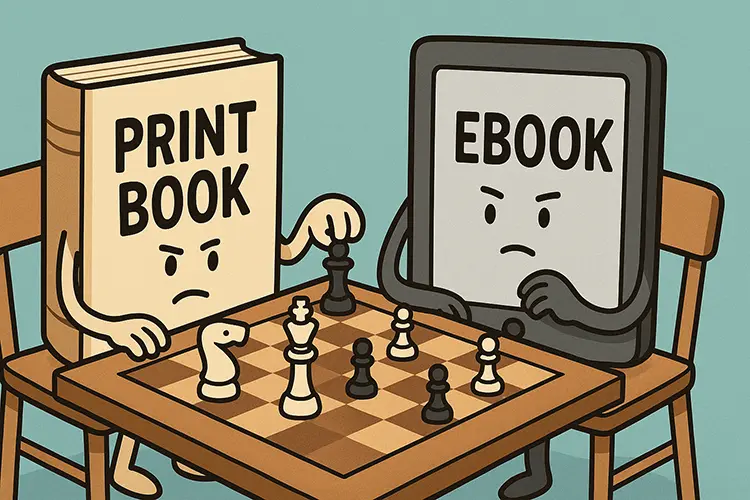
When publishing a book, authors must make a critical decision about whether to pursue the print route or the ebook route. In Part I of this two-part series, we discussed the advantages of sticking to the old-fashioned way and opting for print.
Now, in this second installment, we’ll look at the circumstances under which authors might rather lean toward the more modern ebook option.
The general direction of society has, in many ways, shifted in a more digital direction for many aspects of life, and literature is no exception. This has, in part, been heavily influenced by certain world events that have forever altered the landscape. One major recent example is COVID-19. In the early days of the pandemic, many readers had fears about venturing out in public (and thus potentially catching the deadly virus). Staffing shortages in the postal services also made it difficult to order print books online, since they could not be delivered in a timely manner. The result was a sharp uptick in ebook interest, since ebooks don’t require physically interacting with others at a store, nor do they have to be delivered by another human.
But even once the health crisis began to subside, the ebook popularity influx did not. Instead, the ebook became permanently more prominent in everyday life; it’s here to stay!
As mentioned in Part I, there are three main groups of factors for authors to consider before making this choice:
- Audience and demographic. Who, exactly, is the book being written for?
- Cost. What kind of budget is an author on, and what aspects of the book are most crucial when considering that budget?
- Subject matter. What type of medium is best suited to the topic(s) of the book?
Which Audiences Might Prefer Ebooks?
For some demographics, print will always be king. But the flip side is true, too; plenty of audiences have a strong preference for the digital counterpart. Polls have shown, for example, that ebooks have the popularity edge over print books in younger readers (i.e., under the age of 45), and they are also more popular among women. So, if an author is writing specifically for either of those groups, choosing the ebook would likely be a wise investment.
Frequent travelers are typically among those who would much rather use ebooks, because carrying one computer with 10 books is much easier than trying to pack those 10 books in a suitcase—the latter would be VERY heavy! By that same token, when packing up to go from place to place, it’s far more difficult to remember to pack all 10 of those books, as opposed to just remembering to pack one small tablet or Kindle.
Cost Matters
As mentioned in Part I, things can get a little tricky when it comes to factoring cost into print versus ebooks. The factors are fairly complicated and touch on many different areas—such as retailer payments to publishers and royalties paid to authors—before an author can accurately compute the bottom line.
Still, one thing is certain: Authors who opt for an ebook won’t have to worry about the added costs associated with printing a book onto physical paper and distributing it. As a result of recent inflationary trends, along with environmental ones, the cost of paper has skyrocketed—and over the next decade, it’s likely to only get worse. Thus, eliminating those costs with an ebook can make a significant difference at the end of the day.
Other types of costs associated with print books might be less obvious, but potentially equally impactful. Take, for instance, the space and storage equipment required to keep print books on hand. If you have a large enough collection, you’re going to need some kind of bookshelf, which isn’t cheap—and if you ever move, that piece of furniture is going to have to move with you, tacking on additional costs.
Space constraints are another important consideration. There is a finite number of books that one bookshelf can hold, which means once you exceed that number, it’s going to necessitate shelling out the cash for yet another bookshelf. Meanwhile, ebooks require no physical storage space whatsoever—and aside from your computer’s memory limit, there’s no cap on how many ebooks a single device can take.
Color images also typically create a much higher cost for authors who choose to print books, since printing in color tends to be more labor intensive. Digital color images, on the other hand, are typically associated with few (if any) additional fees compared to black and white ones. So, if an author’s book relies heavily on color in images—whether for the cover, the illustrations inside, or both—the digital format could create the most value with the fewest expenses, thereby driving up the bottom line.
What About Topic?
The latest studies point to certain fiction genres—such as mystery, suspense, and science fiction—as being the most popular among ebook readers. In terms of nonfiction, the statistics show that ebooks tend to win out when it comes to subjects like self-help and fitness.
Regardless of the genre, authors should also look at how much their book relies on reference listings. A generation ago, if a book had hundreds of reference citations, authors had little choice but to list them all in a references section, which could be very difficult for readers to follow. With ebooks, all of that has changed—tools like hyperlinking can instead interactively take a reader directly to that listing. This provides significant incentive for an author to create an ebook format for reference-heavy content.
For similar reasons, authors might consider going digital for a book with subject matter focusing heavily on social media—a topic that is gaining more traction in literature by the minute. Yes, it’s possible to discuss social media using just a pen and paper. But it’s entirely more effective when there’s a way to immediately access the social media being discussed, which is only possible with a digital format.
Final Thoughts
Aside from these factors, there is also the issue of the amount of time before a book reaches a consumer’s hands. In the case of a print book, one of two things has to happen before a reader can dive in. The first option is that a reader has to drive to a physical store to buy the book, which takes up both time and gas. The other option is for a reader is to order the print book to be delivered to their home. But, with issues like weather and staffing shortages often impacting delivery services, this could mean a days-long wait—maybe even a week or more! An ebook, on the other hand, just requires a few simple keystrokes, cutting out the tedious waiting process.
While there is no “right” or “wrong” answer for an author as to whether print books or ebooks are best, there are definite pros and cons that hinge on the individual project. Because of the complexity of these pros and cons, it might behoove an author to seek multiple opinions from multiple experts in the field before making a final call, since every case is unique. Yes, it’s always possible to change from print to ebook (or vice versa) later on. But by getting it right the first time, authors can best hit the ground running with their creative masterpiece that has taken so much time and effort—and deservedly so!
View Part One in this series here.
By Anne Brenner
Anne is an Assistant Managing Editor at Technica Editorial