| |
|
|
Hello, October!
As the season shifts and writing routines settle back in, we are excited to bring you the next installment in our writing series. In this issue, we dive into what characters aren’t saying—exploring how subtext brings dialogue to life and keeps readers hooked.
We also take a close look at the crucial production and design decisions every author should navigate long before upload day, along with the latest industry legal updates and a client spotlight.
Grab a warm drink and dive in!
Happy Reading!
|
|
|
|
What’s Really Being Said? A Dialogue & Subtext
Checklist
|
|
Last month, we kicked off our four-part series on drawing
readers into your story and keeping them there. We talked about the first five
pages and why a strong opening is really about earning reader trust.
This month, we’re taking that idea one step further. Once
you’ve earned that trust, you have to be willing to use it. As hard as it is,
sometimes that means not telling readers everything.
What’s Left Unsaid
If you’ve ever written a scene where the dialogue is
technically fine but something about it just feels . . . flat, subtext may be
what’s missing.
Maybe your characters are talking. They’re answering each
other’s questions. They’re saying what they’re thinking. They’re explaining how
they feel.
That’s all well and good, but it’s also exactly the problem,
because people don’t usually communicate that way.
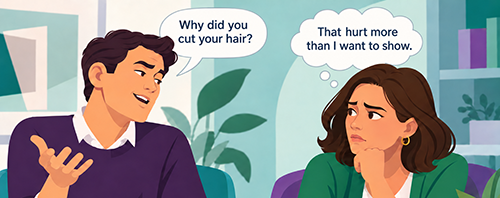
Here’s a little exercise for you: Think about the last
uncomfortable conversation you had with someone you know well. Did you both
calmly explain exactly what you were thinking and feeling?
We did this exercise in-house and the results were
interesting. Most of us did not say what we were thinking or feeling. Some said
things like, “I’m fine.”
Others changed the subject.
One person said she started loading the dishwasher with a
lot of enthusiasm!
The message here is that what was said mattered, but what
wasn’t said probably mattered more.
That’s subtext.
What Is Subtext, Really?
In a nutshell, subtext is the meaning underneath what’s
actually being said or done.
A character might say: “You’re home early.” That sounds
simple enough, right? But what does it really mean?
It could mean:
I’m happy you’re here. Why are you here? You weren’t supposed to see this. I thought you were with her. I’ve been waiting for you.
The words the character said haven’t changed, but what’s
underneath them has.
And as writers, that subtext—what’s not being said—is where
the fun lies. It’s where things get interesting.
At Technica Editorial, we often see writers working very
hard to make sure readers understand exactly what’s happening in a scene. That
instinct makes sense. None of us wants readers to be confused.
But a big point of confusion is understanding the difference
between clarity and explanation.
Readers don’t necessarily need every emotion interpreted for
them. What they do need is clarity.
|
|
|
|
|
|
|
|
|
|
The Authors Guild AI, copyright, and author rights remain a major story across the publishing industry. On September 4, The Authors Guild and its co-plaintiffs filed a motion for summary judgment in their ongoing copyright litigation against OpenAI and Microsoft. Concurrently, the claims process connected with the Anthropic copyright litigation continues, with updated claim information sent to eligible claimants this month. Rather than getting deeply legal, your author newsletter could frame this as: “Why Authors Need to Know Where Their Rights Are—and Who Controls Them.”
Publishing’s AI Reckoning
Using AI Responsibly in Scientific Publishing
AI is becoming part of the publishing workflow—not just the writing process. Publishers are increasingly using AI for tasks such as proofreading, translation, metadata development, and accessibility work. At the same time, the industry is grappling with questions about transparency, copyright, and how AI use should be disclosed.
|
|
|
|
Things We Don’t Think About—But Should
|
|
Finishing
your manuscript feels like a major milestone—and it is. But before your book
moves into design and production, there are several decisions worth making
first. A little planning now can prevent delays, unexpected costs, and
last-minute changes later.
|
Who owns every element in your book?
|
Photos, illustrations, maps, song lyrics,
epigraphs, screenshots, charts, and long quotations and excerpts may require permissions. Secure these early on.
|
|
What
trim size will your book be?
|
Trim
size determines much more than appearance. It influences page count, spine
width, printing cost, margins, typography, and even cover design. Note that different genres have distinct trim sizes. Choose the trim size before typesetting.
|
|
What happens when your book changes
formats?
|
A design that works in print may not work in ePub,
large print, or audiobook. Plan for various formats early, as it may influence scene writing.
|
|
Are
you designing for the reader—or yourself?
|
Fonts,
trim size, margins, line spacing, chapter openings, and running heads should
support the reading experience rather than simply reflect personal taste.
|
|
What will your book look like as a
thumbnail?
|
Covers are increasingly encountered at very small
sizes. Can readers still understand the title, genre, and visual hierarchy?
|
|
What
happens after someone finishes your book?
|
Consider
backmatter strategically: newsletter signup, website, other books,
discussion questions, resources, acknowledgments, or calls to action.
|
|
Have you planned for corrections after
publication?
|
Authors rarely think about version control. What
happens when you find an error after uploading to a platform? Establish a version-control strategy.
|
|
Are
your links going to age well?
|
URLs,
QR codes, social handles, organizations, statistics, and resource lists can
become obsolete surprisingly quickly. Choose durable links or permalinks.
|
|
Does your book need an index?
|
Typical for nonfiction. Authors often decide
this too late, when pagination and production schedules are already fixed.
|
|
What
does accessibility mean for your book?
|
Screen reading capibility, alt text for images, structured headings, contrast compliance, accessible EPUB/PDF are increasingly becoming a standard part of professiona publishing.
|
|
Have you budgeted for the whole book—not
just editing?
|
Editing, proofreading, design, ISBNs, images,
permissions, indexing, printing, distribution, marketing, and revisions can
all affect the real cost.
|
|
Is
your metadata saying the same thing as your book?
|
Ensure your title, subtitle, description, BISAC categories, keywords, cover, and opening pages
should project a unified message to your targeted audience.
|
|
What belongs on the copyright page?
|
The copyright page should include: the copyright
notice, ISBN, publisher information, rights & permissions, edition statement,
disclaimers, credits, and CIP/LCCN.
|
|
Have
you thought about your book as intellectual property?
|
Beyond
selling copies: translation rights, audiobook rights, film/TV rights, foreign
rights, licensing, serialization, and derivative works.
|
|
What happens to your book files five
years from now?
|
Authors should maintain organized source files,
fonts/licenses, images, cover files, ISBN information, metadata, and final
editions rather than relying solely on a publishing platform.
|
|
Do
you need a sensitivity, technical, or expert review?
|
Copyediting
isn’t always enough. Some books benefit from legal review, fact-checking,
subject-matter review, permissions review, or sensitivity reading.
|
|
Is your book actually finished—or just
finished being written?
|
A strong distinction between manuscript completion
and publication readiness: editing → proofing → design & layout → final proofing →
metadata → upload → quality inspection.
|
The Technica Takeaway
Production runs smoothly when key questions are addressed before the
manuscript moves into the layout phase. It’s important to consider the entire
book—not just the manuscript—when preparing for publication.
A
valuable final question to ask yourself before handing your project over to
production is:
“Have I
made all the decisions that my designer, editor, printer, or future self will
need me to make?”
This
single question can save a considerable amount of time and money later on.
|
|
|
|
Project Spotlight:
Sir Blake’s New Purple Violin
by Carmen Ayala Brown |
|
|
|
Technica Editorial was excited to partner with children’s author Carmen Ayala Brown on her new book, Sir Blake’s New Purple Violin. Technica created the book’s fixed-layout epub, and is currently working with the author on her next book project.
|
|
|
|
|
|
Ready to Strengthen Your Book?
Looking to finally finish that manuscript you’ve been working on? Take the next step. Technica Editorial offers editorial support including copyediting, developmental editing, interior page layout and design, cover art, and more. |
|
|
|
|
|
|
|
Seeking additional guidance or inspiration?
Explore our Resources for downloadable author guides and tools! |
|
|
|
|
|
|
|
|
|
|
|
|
|
|
|
|