In the writing, editing, and publishing industry, AI is here to stay, across all aspects of the business. And alt text—that is, a brief text description designed to replace an image in the electronic version of an article—isn’t going anywhere either.
AI is a controversial topic across the board in the writing and publishing realm. Editors and authors alike are understandably apprehensive about making it a regular part of their processes. And many of them are especially nervous about using it for alt text, because it’s such a new and different concept.
In some cases, AI usage can be an asset to generating meaningful alt text that serves its intended purposes: to assist those with visual challenges, provide an alternate route when an image fails to properly load, and helping articles climb the SEO ladder. But in other instances, AI can instead be a hindrance to producing effective alt text. So, while skipping AI entirely might not be feasible in today’s AI-dependent world, it’s at least necessary to do some planning for it across all stages of the alt text generation process: before, during, and after.
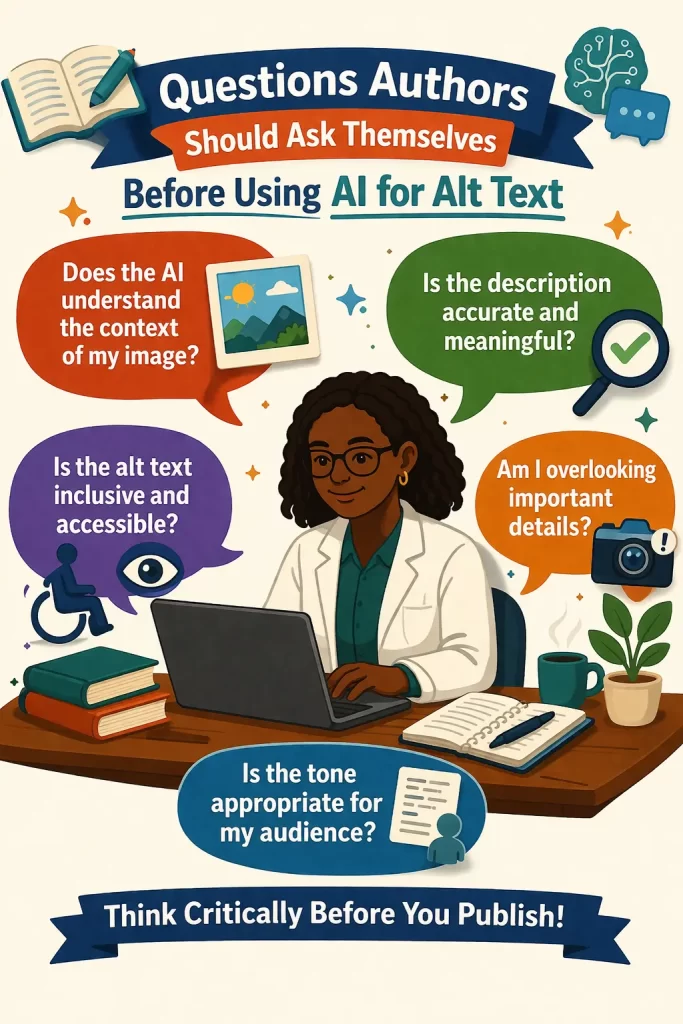
Before turning to AI when writing alt text, authors should ask themselves three key questions. First, what kind of context does the image come with? Second, what is the complexity level of that image? And finally: Is the image in the publication solely for the purpose of decoration?
What Is the Context of My Image?
At least for now, AI isn’t always great at accuracy when it comes to image context. It might add interpretations and/or opinions based on SEO keywords that don’t necessarily apply to the specific image, creating incomplete—or possibly even inaccurate—details about what the image actually depicts.
For instance: Suppose you’re writing an article for a journal about neonatology, and there’s a photo of a female nurse holding a newborn infant in the delivery room. An AI-generated alt text phrase might not provide specific enough context, reading something like, “woman with a baby.” Or, it might even provide the wrong context, assuming the woman is the mother of the baby instead of the delivery room nurse—thus, it could erroneously say, “mother holds her newborn infant.” Obviously, this creates a problem for reader interpretation of the image.
Then there’s the issue of AI-generated context making alt text redundant. Many (if not most) AI tools will automatically insert the words “image of,” “picture of,” or something similar into alt text. But those types of phrases almost always appear in alt text automatically, rendering them unnecessary to repeat. And without proper checking, that repetition is going to end up in the published article.
How Complex Is My Image?
Some types of complex images—such as pie charts, bar graphs, and diagrams—require more complicated analysis when generating AI. If, for example, the image is visually describing trends, cause-and-effect relationships, and/or outliers, it’s not going to always follow the normal rules when it comes to writing alt text.
Generally speaking, the guideline is to be as concise as possible when writing alt text, but in cases like these, it can be tough to do that, since there are more intricate data points involved. It might even be necessary to write two versions of alt text: a brief one to summarize the image, and then a longer one to cover all of the complicated information.
Using AI can get tricky in this type of situation, because it’s not necessarily equipped to perform appropriate analysis of the complex data, nor is it always designed to accurately summarize such complex data points. Let’s say, for example, the image is a pie chart summarizing housing costs in different cities across the United States, and the point of the article section is to focus on one or two cities where it’s abnormally expensive to live, AI might just focus on which colors in the chart refer to which data categories, paying no attention to the outliers—this obviously defeats the purpose of providing the kind of information a reader would need.
If AI is going to be used for this kind of alt text, it might also be helpful to consider which specific AI tool would be best. More generic tools, such as ChatGPT, may not be ideal, because they tend to produce long, convoluted, and disorganized paragraphs that could be difficult for readers to digest if the information is too complicated. Authors might instead consider using AI tools specifically designed for this kind of alt text generation, such as FigurA11y or Invicta.
Is My Image Purely Decorative?
There is, understandably, a debate about whether alt text is appropriate at all in situations where an image is for decorative purposes only—that is, it’s strictly aesthetic, and it doesn’t add any kind of substantive value to an article’s context. The case can be made either way for the use of alt text in these types of situations. But if alt text is used, there’s a great deal of apprehension about enlisting the help of AI to create it, because AI might not understand the difference between decorative and contextual.
A photo of a vibrant rainbow over the New York City skyline, for example, might just serve as a decorative touch in an article about the history of New York City. But in an article about weather, it could add substantial contextual value. And unfortunately, AI is unlikely to catch onto this distinction—at least, not without human help.
So, in the former case—where the image is merely decorative—AI bots could do more harm than help in creating alt text that mentions scientific aspects of the photo, such as UV rays and refraction. This could, in turn, cause confusion for readers, which defeats the intended purpose of alt text.
At this point, it’s probably not realistic to ask authors to refrain from using AI at all when generating alt text for decorative images; despite its imperfections, AI is simply too ubiquitous. And with many authors’ busy schedules, going back to an AI-free lifestyle might be too much to ask. But in situations like this, when images are present exclusively for decorative purposes, it’s critical to at least keep a close eye on AI’s output in alt text, heavily editing it if need be.
Conclusion
The concepts of AI and alt text are both too new to establish any definitive “rules” about their use in writing articles. But the trend is moving toward making alt text highly encouraged, if not mandatory—and within the next few years, the majority of publications may very well decide it’s no longer going to be an option. So, many publications are starting to come up with their own sets of guidelines, but there’s still no overarching policy that can be applicable across the board—and this will likely be true for the foreseeable future.
Still, neither AI nor alt text are likely to be mere fads; they’re around for the long haul. This means authors need to get into the habit of thinking about alt text in the early stages of drafting a publication’s outline—and this also means pondering, early on, about if/how AI will be part of that process.
By Anne Brenner