There’s no better place to look for scares than real life.
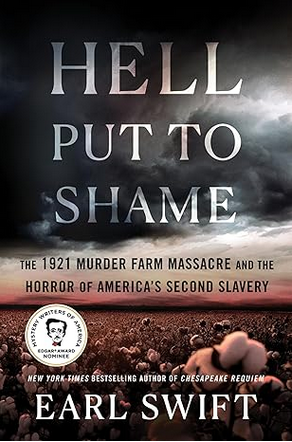
Hell Put to Shame: Thirteenth Amendment, Schmirteenth Amendment—at least, that was how white Southerners would have it after the Civil War and did have it. The injustice of slavery was in many ways simply remarketed [(re)constructed] to create new limits, identical to the first limits for Black southerners. Minor and made-up charges created a financial debt that only physical labor, directed toward a third party, could repay through what was known as “peonage.” Physical violence was just as present in this system as it was before abolition—and people, depending on what they looked like, could get away with murder. Justice was delayed for many…but in Hell Put to Shame, Earl Swift expertly recounts how a small group of people helped bring a little more justice and accountability into the world by exposing the murder of eleven people kept in peonage and prosecuting the man behind it. Some people might call the 1920s the calm before the storm of the Great Depression, but those people may not be looking closely enough to see the rise or preexisting sovereignty of racist and/or nationalist ideologies and movements. But the strength of such insidious and corrupt belief structures inspired others to be strong in resisting them and creating their own movements to counter what would have seemed to be insurmountable obstacles. Hell Put to Shame tells an engrossing narrative, made more engaging through the strength of its writing.
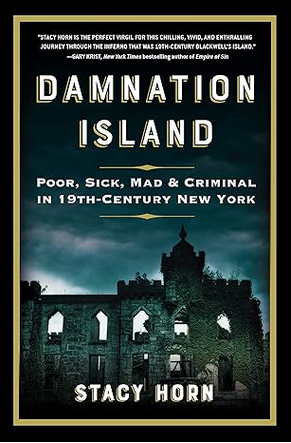
Damnation Island: We all go a little mad sometimes…and there’s nothing like learning about the historical systemic mistreatment of the mentally ill to really help make one madder. Blackwell’s Island in the 19th century was a two-mile-long stretch of misery for New York’s “lunatics” and poor; one that many, once they’d arrived, never left due to those abundant miseries. Ignorance coupled with ableism and classism meant awful living conditions and terrible working conditions for those who were strong-armed into labor—and this was an improvement from eras that all but tortured people under the belief that insanity was caused by demonic influence/possession. Appointments for major positions were made more by politics than qualifications (just imagine) and not enough people were brought on to work, with too little space for too many residents. Residents were segregated by the apparent severity of their condition—Class Two residents were “idiots” (aka, mentally disabled) and epileptics (who were considered insane with violent/criminal tendencies)—and classist/anti-immigrant beliefs further segregated inmates and colored the opinion of those who had authority over them. Some cases that got public attention didn’t cause anything to change on the island even if an unjustly committed/treated resident was released, while consistently low funding meant that even when the occasional well-meaning soul had some authority, there was only so much change they could create, and some of it was just for show. Small wonder that so many people, upon seeing or experiencing a taste of the experience, were horrified, and some horrified enough to act. Stacy Horn, even over a century later, is just as determined to expose the awfulness of the past Blackwell’s Island to the crusaders she names—the likes of clergymen, nuns, journalists, oh my—and is very effective in doing so with Damnation Island. The book makes it clear in unflinching prose that any and all rights for the types of people incarcerated were won by dedicated reformers through hard-fought uphill battles. Damnation Island: one hell of a good book.
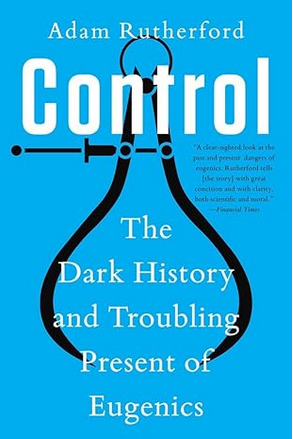
Control: As geneticist Adam Rutherford sadly notes in the foreword to Control, science, which should be objective, is made political by the forebearers and the social intertwinements of biology. Societies sought to make themselves stronger and to control the population by eliminating people who apparently didn’t deserve to make the cut, using various justifications for this cruel indifference. In many ancient cultures, including but not limited to the Romans, it was common practice to “separate the sound from the worthless” (in the words of the Roman philosopher Seneca) through the infanticide of children apparently born weak or deformed. The late 19th century/early 20th century preferred to more covertly lock up its “lunatics,” a catch-all term for various undesirables, away from industry and order in asylums. Racist doctrines throughout ages and countries made it much easier to find “undesirables” that threatened the purity of White supremacy, written about in multiple pseudoscience books in the early 20th century. It’s genuinely disturbing to know just how many people in that era who are otherwise admired (Theodore Roosevelt, Margaret Sanger, W. E. B. DuBois among others) at one point or another supported eugenics, or even how many people generally supported eugenics. In forms such as sterilization of those born with “defects,” it was perhaps easier to justify a supposedly milder form of societal cleansing. The world was given a traumatizing lesson in WWII, based on many lessons that the Nazis learned from American legislation, on how the ultimate endgame of eugenics would look… but not everyone learns easily, and lessons don’t always stick. New understandings of genetics and gene data and reproduction in the years following have helped revive interest in eugenics: gene editing, selecting certain embryos, faux-health crusades. Rutherford knows what he’s writing about in all aspects, and that clearly shows in a relatively short but undoubtedly compelling book; hard to read for its subject, easy to read for its clarity. Don’t bother to control any interest—it’s a waste of effort.
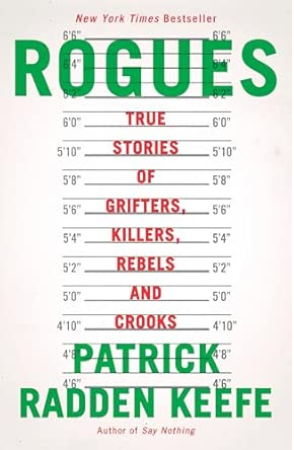
Rogues: Patrick Radden Keefe made his bones on the backs of bad people… thankfully, by writing about them. The book Rogues is compiled from a collection of his articles written for the New Yorker, and now readers of all sorts have an opportunity to read a dozen of his best stories and works. No two chapters are the same: one focuses on a woman who turned in her gangster brother and helped bring him to legal justice and who now lives in hiding and fear for the consequences, while another spins the details on capturing a major drug lord with the alias of “El Chino Ántrax.” However different they might be, though, they all grip, hurt, and hit. Inherent questions come up: whether “rogues” exist due to nature or nurture, how much can be blamed on society, are there enough system blockades in place for gun control (short answer: No), and what was done versus what was needed in the case of rampant crime. Rogues unveils the counterfeit, but it’s the real deal.. It tells us stories of thieves, but any price paid for it is a steal. This book tells stories of murders—and it slays.
By Grace Dietz
Grace is an Editorial Assistant at Technica Editorial