
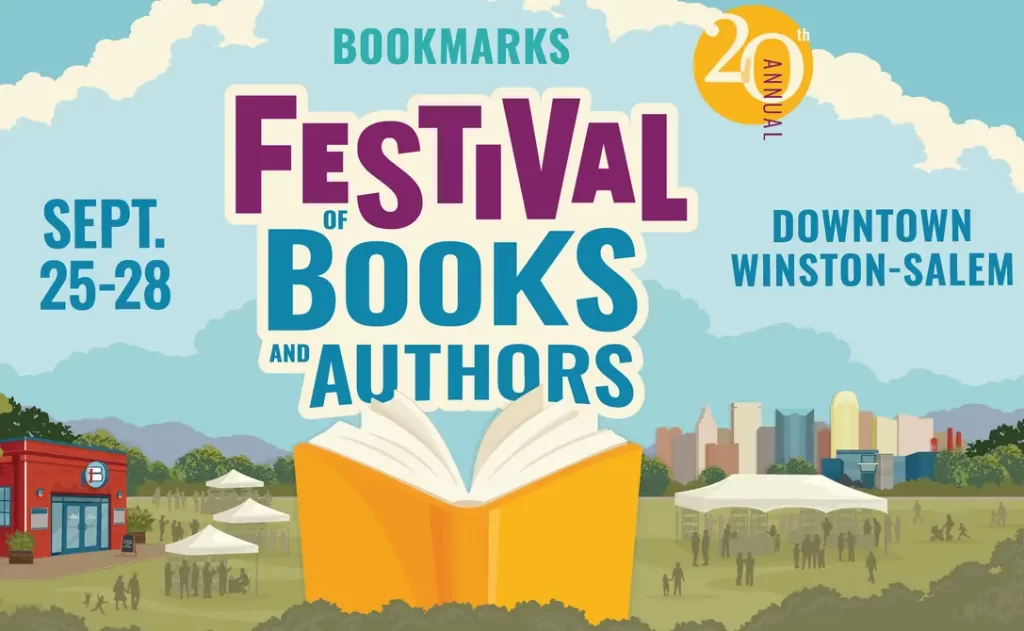
On September 27, 2025, I attended the Tor Talks: A Sci-Fi/Fantasy Sampler panel at the Bookmarks Festival of Books and Authors in Winston-Salem, North Carolina. The panel was moderated by Bookmarks Board Member Jamie Wallis, and it featured authors Maddie Martinez, Annalee Newitz, John Scalzi, and Nghi Vo. Maddie was there to promote The Maiden and Her Monster, a folklore fantasy about a healer’s daughter who forms a relationship with a monster and also discovers who the real village monsters are. Annalee was promoting Automatic Noodle, a science fiction novel about abandoned robots who open a restaurant that serves humans in a war-torn San Francisco. John was promoting The Shattered Peace, the seventh installment of the Old Man’s War series, which details (in part) augmented humans and the battles and negotiations they wage with various alien races. And Nghi was promoting A Mouthful of Dust, the second installment of the Singing Hills Cycle, about a wandering cleric who documents the tale of a village famine.
Moderator Jamie Wallis asked each of the authors about the following topics, and here are condensed versions of their responses:
The Genesis of Your Novel
Annalee described the genesis of their novel as a love letter to San Francisco, though within a post-apocalyptic setting. Nghi described her novel as dealing with hunger and desperation. Maddie’s novel was birthed from her love of Jewish folktales and fairytales. She also studies how stories are fused with politics, and she likes to focus on how powerful it is to hope and to question everything. John jokingly described his book as a relentless cash grab. However, he then said that a major takeaway for readers should be that the world is on fire, but hopefully his novel provides escapism.
The Politics of Your Writing
John noted that we live in a political framework, so it is difficult to remove people from this framework when authoring a novel. If you do this, you lose context, and context matters. For Maddie, it is important for her to make humanity shine when authoring a novel. For Nghi, there is no safe space to be, and we use humanity as a stand-in for value. In that
sense, a novel’s characters should be presented as inherently valuable. Annalee explained that the robots in their novel are kind-of citizens and kind-of not. For example, they can work jobs, but they cannot vote. Both humans and robots are dealing with life and death issues. The stakes are low for the robots (selling noodles) but are set against a dire backdrop (the robots do not have rights in the United States outside of San Francisco).
Your Inspiration To Write
Maddie was inspired by the collapse of the Catholic Church in the late Middle Ages, as well as by the connection between rising religious nationalism and a plague while she authored her novel during the pandemic (as there were also religious nationalism and a plague in the late Middle Ages). Nghi was inspired by the Body Worlds exhibit, which is a controversial traveling exhibition featuring real human bodies stripped of skin and preserved through a process called “plastination.” She considered it to be beautiful as well as dark, and she was filled with feelings of grief, but then hunger. Nghi also noted that cannibalism is deeply ingrained in human culture and in nature (for example, tiger salamanders are known to eat their siblings). Annalee was inspired by needing to be comforted from the bad feelings brought on by having recently written a nonfiction book about psychological warfare. They were also inspired by their love of noodles and robots, and authoring the novel was a happy place for them. Still, they noted that psychological warfare still seeps into the novel, describing it as a weird combination of comfort and horror. John did not always intend to be a novelist. Growing up, he wanted to be a newspaper columnist, like Mike Royko, Molly Ivins, Dave Barry, and others. His first job was as a film critic, so he also looked up to writers such as Elaine May and Ben Hecht. Therefore, there is movie-like dialogue in the Old Man’s War series, as well as observational narration. John was also inspired by (and appreciative of) how diverse the sci-fi author landscape is today.
What You Appreciate About Speculative Fiction
Annalee explained that speculative fiction represents a sandbox in which authors can test out ideas, allowing them to ponder the question, “What if we imagined things in this one particular way?” They also described speculative fiction as a gentle way to think out alternative realities. John explained that speculative fiction is capacious, in that authors can explore so many genres within the genre, including crime, humor, and action & adventure. In other genres, authors have to explain their line of thinking as to why they blend genres. Maddie explained that speculative fiction authors can push the boundaries of readers’ comfort while providing distance from uncomfortable topics, since those authors can take liberties with objective reality. They are also able to talk about genuine issues while grossing out readers.
Pantser or Plotter
Annalee came up through journalism, so they outline their novels to know where they are going. They write toward specific scenes and write these scenes on Post-it notes to use as a guide. After first joking about an alternate meaning for “pantser,” John said he is more of a pantser, though he does not like the term because of the inappropriate suggestion. He further explained that he can write quickly because of his journalism experience. Maddie considers herself to be a “plantser,” with her process being in between outlining a fully plotted novel and writing-as-you-go. She has an idea about a plot point at the beginning, middle, and end of the novel. She said this is a chaotic process, but she just needs these three touch points to effectively author a novel. Nghi uses a notecards system, and paying rent helps her focus on deadlines. She is not too precious about words, so she is willing to lose thousands of words to meet a word count requirement for a novel.
The Benefits And Drawbacks of Writing Commercial Fiction
John can write whatever he wants to write, but it has to be accessible and explainable in one or two sentences. Maddie is aware that as a debut author, she might not get another opportunity to publish if she does not write something commercial. She also explained that collaborating with an editor helped her shape her novel into a commercial product. For Nghi, the best part of writing commercial fiction is having an agent to tell you if something is great. But she will also write what she wants, regardless of whether it gets sold. Annalee joked their whole goal is to trick editors into buying more stuff from her. However, her editor helps her dial back explicit scenes and address pacing problems.
Conclusion: My Experience at Bookmarks Festival of Books
After Jamie Wallis’ questions, he announced a Q&A, but I left to get in line for John Scalzi’s signing. The author signings all happened under one tent, and each line was clearly labeled. That mostly helped, though some people were confused if the line for John Scalzi was correct because it was so close to another line. And though Scalzi’s line was long, it was much shorter than lines I have been in at fan conventions such as Galaxycon. So, I appreciated the convenience. There was also a separate tent for book sales, but I did not visit it because I brought a copy of Scalzi’s The Kaiju Appreciation Society from home. There were also tents nearby for festival information and Bookmarks merchandise. More quickly than I expected, I arrived at the front of the line, got my picture taken with the author, and got my book signed. I told him that I had only recently started reading the Old Man’s War series, so it would be a while before I read The Shattered Peace. He was fine with this, telling me that since the rest of the books were available, they would be waiting for me whenever I was ready to read them. Overall, visiting the Bookmarks Festival of Books was a fun experience, and one I highly recommend to North Carolina residents or visitors.
By Matt Wade
Matt is an Editorial Assistant at Technica Editorial